

hospital

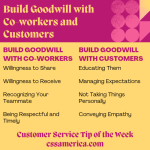
Build Goodwill with Co-workers and Customers - 11/10/26


All relationships are different.  We want to have good relationships with co-workers, after all – those are the people we spend the most time with each week.  We want to have good relationships with customers since they’re the ones that provide the revenue and inflows that allow us to Read more

How to Avoid “Groundhog Day” - 11/3/26


It’s Groundhog Day, where you’re living the same day over and over and over again. You have heard basically the same complaint from 4 different customers in the past week.  The bill is incorrect or confusing, and you’re having to spend a ton of time explaining things to the customer. You’ve Read more

Beware of Scary Telephone Customer Service - 10/27/26


As we near the Halloween holiday in the United States, it seems appropriate to discuss examples of scary customer service, particularly on the telephone.  Here are a few common issues that frustrate and annoy customers.  These are experiences to avoid delivering, and alternatives to adopt: The customer calls, describes their Read more

The Art of the Successful Script - 10/20/26


You’re the customer.  You go to the store, and they ask if you have a loyalty card.  You call the doctor’s office, and they ask for your birth date.   You walk up to the counter, and they ask if you found everything you were looking for. These are all valid Read more

The Key Building Block for Your Customer Relationship - 10/13/26


An automotive manufacturer gets supplies for their vehicles from all over the world.  They have arrangements, service level agreements, expectations for timing and quality of all the parts.  And when they gather all these supplies, they assemble the cars.  They test the cars.  Then they take pictures of those Read more

Be Flexible to Fill the Gaps - 10/6/26


The non-profit has the expected challenges.  There are only 3 people in the organization, yet, they have the same responsibilities of a larger company.  They have to do finance, sales, marketing; they deliver their services to the community, and they need to keep a pulse on what’s going on Read more

Is This Good Customer Service? - 9/29/26


A friend of mine reached out to me recently as she waited for the electrical technician to show up at her house to do some minor repairs.  She had never worked with this company before, but they sent a text about the tech who was soon to arrive. The message Read more

Ownership when Fixing Others’ Errors - 9/22/26


We were conducting training with a client recently, and one of the participants, Jackie, is in a role in his organization where he goes out to the customer site to investigate issues, address customer complaints, and fix problems.  While he’s at the site, he often gets an earful from Read more

Why “No” is So Important - 9/15/26


The employee told the caller: “I don’t think that is possible.” The customer eventually hung up, and redialed to ask a different employee the same question. The employee responded to the customer: “That’s probably not the best way to do it.”  Then, the customer kept asking question after question, arguing Read more

It’s Not “You,” It’s “I” - 9/8/26


During a business writing course that I took years ago, the instructor had us write an e-mail.  I can’t recall if it was written to a co-worker or customer, but after writing this e-mail, she had us count every “I” and “You.”  We talked about how we need to Read more

Don’t Wait on Fixing Waits

Posted on in Business Advice, Healthcare Please leave a comment

Where do you hear the loudest customer complaints in the typical hospital of today? It’s the Emergency Room.

“Why have I waited so long?!” “Why did that person on the stretcher go back to a room before me?! I was here first!” “I’ve been here 2 hours, and nobody’s told me anything!”

These complaints are pervasive, but they also point to the impact of customer service. Remember that customer service involves processes. Customer service is part employee attitudes/skills/knowledge, and the other part is process. How long something takes, how long are the waits, how efficient is a process, how redundant are the processes, how smooth the flow of information and people is or isn’t – those are all characteristics of process.

And whereas businesses spend lots of money every year to have employees trained on how to deal with irate customers, a tactic just as valuable as that is to identify the root causes of why customers are irate and to address those root causes. In healthcare, so many of those complaints are about one thing – process.

So if you want your organization to be better from a customer service-perspective in your customers’ eyes, if you want to reduce the number of conflicts with customers which your employees have to address, then fix your processes. Find out where waits exist, the cause of the waits, the communications during the waits, and perceptions of the length of the wait time, and address them.

Many of our clients redesign departmental layouts, they change processes, they do a better job of scheduling staff to flex up/down with variations by time-of-day or day-of-week with customer volumes or arrival rates. They train staff on how to and how often to interact with customers during wait to provide updates, keep them engaged, convey they care, and – ultimately – to reduce the perception of the wait time. The clients create activities for the customers or distractions which help to reduce the perception of the wait times.

In other words, the hospitals and other organizations best at dealing with waits try to reduce wait times while at the same time reducing the perception of waits.

Wait times are a symptom of an issue with your customer service. Don’t wait on fixing waits.

Interested in improving your company’s customer service? See more information at: http://www.cssamerica.com/


« Previous   1 2 ... 7 8 9 10 11 12 13 14 15 16