
customer experience

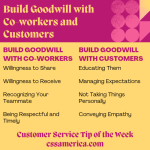
Build Goodwill with Co-workers and Customers - 11/10/26


All relationships are different.  We want to have good relationships with co-workers, after all – those are the people we spend the most time with each week.  We want to have good relationships with customers since they’re the ones that provide the revenue and inflows that allow us to Read more

How to Avoid “Groundhog Day” - 11/3/26


It’s Groundhog Day, where you’re living the same day over and over and over again. You have heard basically the same complaint from 4 different customers in the past week.  The bill is incorrect or confusing, and you’re having to spend a ton of time explaining things to the customer. You’ve Read more

Beware of Scary Telephone Customer Service - 10/27/26


As we near the Halloween holiday in the United States, it seems appropriate to discuss examples of scary customer service, particularly on the telephone.  Here are a few common issues that frustrate and annoy customers.  These are experiences to avoid delivering, and alternatives to adopt: The customer calls, describes their Read more

The Art of the Successful Script - 10/20/26


You’re the customer.  You go to the store, and they ask if you have a loyalty card.  You call the doctor’s office, and they ask for your birth date.   You walk up to the counter, and they ask if you found everything you were looking for. These are all valid Read more

The Key Building Block for Your Customer Relationship - 10/13/26


An automotive manufacturer gets supplies for their vehicles from all over the world.  They have arrangements, service level agreements, expectations for timing and quality of all the parts.  And when they gather all these supplies, they assemble the cars.  They test the cars.  Then they take pictures of those Read more

Be Flexible to Fill the Gaps - 10/6/26


The non-profit has the expected challenges.  There are only 3 people in the organization, yet, they have the same responsibilities of a larger company.  They have to do finance, sales, marketing; they deliver their services to the community, and they need to keep a pulse on what’s going on Read more

Is This Good Customer Service? - 9/29/26


A friend of mine reached out to me recently as she waited for the electrical technician to show up at her house to do some minor repairs.  She had never worked with this company before, but they sent a text about the tech who was soon to arrive. The message Read more

Ownership when Fixing Others’ Errors - 9/22/26


We were conducting training with a client recently, and one of the participants, Jackie, is in a role in his organization where he goes out to the customer site to investigate issues, address customer complaints, and fix problems.  While he’s at the site, he often gets an earful from Read more

Why “No” is So Important - 9/15/26


The employee told the caller: “I don’t think that is possible.” The customer eventually hung up, and redialed to ask a different employee the same question. The employee responded to the customer: “That’s probably not the best way to do it.”  Then, the customer kept asking question after question, arguing Read more

It’s Not “You,” It’s “I” - 9/8/26


During a business writing course that I took years ago, the instructor had us write an e-mail.  I can’t recall if it was written to a co-worker or customer, but after writing this e-mail, she had us count every “I” and “You.”  We talked about how we need to Read more

While I’ve Got You on the Phone… – 1/6/26

Posted on in Customer Service Tip of the Week Please leave a comment

I’m a big planner.  Whether it’s strategic planning or planning out the year or planning my week first thing on a Monday morning, I like to plan.  I do this because it gets all of my action items documented and ensures that I have some understanding of what I can accomplish every day/week/month.  I like to know what the “Big Rocks” are – to use a Stephen Covey phrase – as I make sure to address these top priorities.

A pitfall I run into is that sometimes I’m so big on planning that I don’t take an action that presents itself in the moment.  I, instead, put it on the To Do List to address later.  This has been an issue of mine that I’ve been working on for years, and I’m always amazed when I see people who don’t have this same issue.

How do I know that they don’t have this issue?  I know because I witness it when I am the customer, and they are the employee.  Here are 3 examples…

Instead of telling me that they will follow up to schedule our next meeting, during the conversation they ask if I have my calendar available so we can go ahead and schedule that meeting.

There are a couple things that the employee and I will have to deal with over the next couple months, so instead of just putting that on their To Do List, they will say: While I’ve got you on the phone, do you have 5 more minutes to address two other quick points?

We’re about to wrap up our phone call, and they just described that the next step is for me to fill out a form.  Before they end the call, they say: I’ll be happy to guide you through the completion of that form right now, if you would like.

There are so many benefits to taking this approach in terms of time savings for your organization and your customer, engendering goodwill, and increasing the likelihood that timelines are met.

When laying out a next step with the customer, offer to address it RIGHT THEN.

Signup for FREE Tips!    Contact Us    More Resources for You    Visit Our Home Page


Pass the Quick Impression Test – 12/30/25

Posted on in Customer Service Tip of the Week Please leave a comment

Some studies have shown that people create an impression of you in less than a second when they first meet you face-to-face.  Other studies have shown that that initial impression can take up to 7 seconds.  Regardless, first impressions are quick.  First impressions are not always the lasting impression, but they can color the customer’s perception of the employee or the organization that affects their demeanor during the encounter.  First impressions can create an immediate conclusion that, if negative, must now be overcome.

Let’s say you’re the customer.  You pull up to the teller window at the bank with no other customers around.  The two employees in the teller window are talking and laughing with each other and not acknowledging you.

You walk into the home improvement store, and three employees walk by you without making eye contact.  You start to feel they are purposely avoiding you.

You are waiting to check out at the retail store, and the employee is looking at their computer screen while reaching out with their left hand for you to give them the clothes you’re purchasing.  No eye contact, no smile, no words…just an outstretched hand.

The customer can tell a lot about a company very quickly.  And maybe their conclusion is not accurate because they’re basing it on something they experience in less than 7 seconds.  However, that quick impression either gets the encounter started positively, or it can put the employee behind the “8 ball” right off the bat.

Don’t risk allowing a negative immediate impression to become a long-term perception.  Make sure that when customers experience your details and how you engage them, they are drawing positive conclusions about how much you care about them.

Pass the Quick Impression Test.

Signup for FREE Tips!    Contact Us    More Resources for You    Visit Our Home Page


Make the Long Wait Feel Shorter – 12/16/25

Posted on in Customer Service Tip of the Week Please leave a comment

When Greg entered the Tax Office, he was thinking only about two things: (1) How he was going to get the tax value on his home reduced, and (2) Whether the wait would be 1 hour or 2.  He checked in with the navigator who asked a few questions, gave him a number, and asked him to take a seat.

After filling out some paperwork on his appeal, Greg had a seat in the waiting room.  He watched some TV, read a magazine with some information for men in their 50s (after all, 50 is the new 40…apparently), and then was greeted by an employee.  The employee updated Greg on his current place in line, what the appeal process would be once Greg met with an appeals coordinator, and asked if Greg had any questions about the paperwork or the process.

After chit-chatting for another minute, the employee said that he’d be back within 10 minutes if Greg had not been brought back, and would give him another update.

About 7-8 minutes later, the employee came by while Greg was looking at some paintings on the walls from local artists, and reading the plaques that noted the history of the areas.  They chatted some more, Greg was told that there was only 1 more person in front of him, and he continued the wait.

When the appeals coordinator came out to greet Greg, she apologized for the wait and appreciated Greg’s patience.  Greg replied: The wait wasn’t too bad – staff were nice, and the waiting area is really interesting.  [then looking at his watch] Oh!  I didn’t realize I’d been here about an hour; seemed like 20-30 minutes!

Wait time is not always perceived to be what it is; if you do a good job of keeping the customer occupied and informed, of showing empathy and respect, even the long waits can feel shorter.

If you can’t shorten the wait, help it to FEEL shorter to the customer.

Signup for FREE Tips!    Contact Us    More Resources for You    Visit Our Home Page