empathy

Manage New Customer Expectations - 8/11/26


The fan had never been to a motorsports event before, but they had been to concerts.  They had been to big conferences.  At those other events, they could park right next to the venue, many of the activities were indoors, and weather was a non-issue.  So, they were not Read more

Complement Empathy with Action - 8/4/26


A man falls into a hole, and he can’t get out.  He starts yelling for help, and a doctor walks by and looks down the hole.  The man in the hole yells to the doctor “Please help me.  I’ve fallen into this hole!”  And the doctor takes out a Read more

My 8-Minute Visit at the DMV- 7/28/26


I needed to get a Real ID, which in North Carolina facilitates airline travel and other identity verifications.  My wife suggested I go to one particular DMV that was a LONG way away from home, but where she had experienced great customer service.  I was lucky to find an Read more

When They Might Walk Out the Door…Permanently- 7/21/26


Have you ever had one of those conversations with the customer where they literally tell you they’re about to stop doing business with your company?  This is it.  They may bring up a competitor or found another way to get their need met, or they are just leaving. When we Read more

Transparency in Customer Service- 7/14/26


We’ve worked with a lot of clients in the local government sector, and many of these clients have Customer Service Standards and/or corporate values that include Transparency. Think about an old-fashioned transparency sheet, that malleable see-through page you put on an overhead projector.  You can see everything on one side Read more

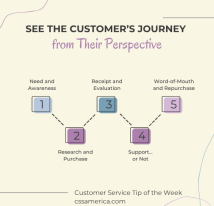
See the Customer’s Journey from Their Perspective- 7/7/26


That customer is face-to-face with you right now, and you are fielding their questions or delivering your service to them.  And oftentimes and understandably, we are so immersed in the moment that we don’t think about what came before or think enough about what comes next. But in the life Read more

Gaining the Benefits of the Greeter- 6/30/26


Most likely, we’ve all entered some establishment – a retail store, restaurant, or service center - when there is a greeter at the door.  The most famous greeter position is probably the Walmart greeter.  I often thought that my father-in-law would have been a fantastic Walmart greeter, because he Read more

Seamlessness - Why the Customer Thanked You - 6/23/26


This doesn’t happen enough nowadays, but the employee received a long thank you e-mail from the customer.  A financial services account manager had taken care of the client during a period of time that was stressful for the customer. Life was unexpectedly changing quickly, and personal emotions, additional financial responsibilities, Read more

When to Avoid the Escalation - 6/16/26


The customer calls with a complaint, and the easy thing to do is to escalate it to your supervisor. That may also be the right thing to do, but how do you know when to avoid the escalation? Why You Would Escalate The first thing to consider is why you would Read more

Let’s be Clear on Clarity - 6/9/26


When trying to manage expectations, it’s vital to be clear with the customer.  But what specifically does it mean to be “clear?” Clarity is in the eyes and ears of the beholder, so what may be clear to one customer may be unclear to another.  However, there are some basic Read more

Use the Customer’s Words – 4/21/26

Posted on in Customer Service Tip of the Week Please leave a comment

The customer is describing a problem on what they call their “computer.” They mentioned that the “screen” doesn’t “move from one page to the other.” They say that the “website’s name is typed at the top,” and it says sample.com with a “line, and then it says ‘home’ after the line.”

They noted how they’re clicking on “the screen,” but the page doesn’t change.  They try to go “backwards” by clicking the “arrow pointing left,” and nothing happens.

This is a customer calling a technology help desk, and they’re using their words to describe their problem.

Oftentimes, customer service professionals are so knowledgeable about their products and services, their policies and processes, that they carry on a conversation with a customer, responding with terms common to the employee without realizing the audience.

We will talk about devices, monitors, URLs.  We will reference browsers and tabs, icons and more technical terms.  But if we hear the customer using certain terms – even if they are not the technical term WE use – we need to realize something.  If we want to add clarity and bring information to the customer in a manner of speaking that they understand, it’s often best to use THEIR words.

I’m not suggesting that we condescend or talk down to the customer.  I’m saying that the goal is for us to understand each other, and it’s more likely if we – the professional – change on the fly to use terms they’re familiar with than if we try to make them technical experts.  We’ve been trained for years on our technical terminology, so we can’t expect the customer to learn our wording in the matter of a 3-minute conversation.

To enhance the tone of the conversation and create some clarity for the customer at the same time, use their words.

Signup for FREE Tips!    Contact Us    More Resources for You    Visit Our Home Page


Affirming the Customer with Empathy – 4/14/26

Posted on in Customer Service Tip of the Week Please leave a comment

We’ve spoken and written about empathy for the 20+ years of these customer service tips, noting empathy as the most important quality any individual can have if they want to be great at customer service.  We’ve shared that – in order to serve our customers most effectively – it’s vital to have a desire to convey understanding of the other person – what is unique about them and their situation.

And usually when we discuss phrasing that conveys empathy, it relates to your sharing statements like “I can see how ABC can be frustrating” or “I can understand how XYZ could be upsetting.”  You are intellectually conveying an understanding of their feelings, of their position in the matter.

When they share their story, their situation, their challenging emotions, there are other ways you can convey – even more concisely and more simply – some empathy:

“That makes total sense” or “Definitely understandable” or “I get it” or “I understand.”

You’re saying these things with a nodding of the head, with a manner of speaking and a tone of voice that convey warmth and patience.

Even the most simple of “Yes, Sir” and “Yes, Ma’am” in response to those customer comments affirms them, offers empathy.

In these concise examples of empathy, without much being conveyed in your words specifically about their situation, you have to be more conscious of your body language, tone, and focus.  Those communication tools take on greater importance in ensuring you’re conveying affirmation of the person, even if you’re not necessarily agreeing with any points that may be unfounded or untrue. 

When you’re trying to deliver great customer service, empathy is a must, but that doesn’t mean you have to be so specific, so wordy in every communication.  Sometimes brevity is a beautiful thing.

Convey empathy with a few sincere words balanced by a tone and focus to fit the situation.

Signup for FREE Tips!    Contact Us    More Resources for You    Visit Our Home Page


Look for a Stop Sign – 2/3/26

Posted on in Customer Service Tip of the Week Please leave a comment

As a customer service professional, what you say matters.  The information you’re providing is useful.  The direction you’re giving the other person is helpful.  But…

As you’re speaking, you also need to be reading.  Reading the other person.  Watching the customer, determining whether and how they’re receiving what you’re sharing.  And sometimes if you’re really watching the customer – their behaviors, their expressions – you can read their signs, and sometimes the signs say STOP.  They say PAUSE.  They say LET THEM TALK.

When you’re sharing something with the customer or you’re talking to them, and they are flipping through their paperwork or scrolling the phone for some information, they’re not paying attention.  That’s a Stop Sign.

When they look at the clock or their watch, or their eye contact strays elsewhere, that’s a Stop Sign.

When you can tell they’re trying to talk or convey some information or physically moving in such a way that they’re about to burst unless they get their turn to speak, that’s a Stop Sign.

When the brow gets furrowed, like they’ve just been asked to lay out a blueprint for World Peace or provide the algorithm that Google uses to prioritize web searches, they may be unclear or confused.  That’s a Stop Sign.

At this point, it’s not about what we’re saying, it’s about how we’re listening to their body language.  It’s how we’re focused on how they’re receiving or not receiving our message, how they’re paying or not paying attention.

Sometimes the best thing to do in a conversation with a customer is to know when to stop speaking and ask them about their thoughts, or ask if they have something to share, or ask if anything is unclear.

 Look for a Stop Sign.

Signup for FREE Tips!    Contact Us    More Resources for You    Visit Our Home Page