

corporate culture

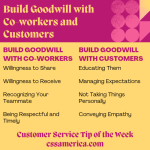
Build Goodwill with Co-workers and Customers - 11/10/26


All relationships are different.  We want to have good relationships with co-workers, after all – those are the people we spend the most time with each week.  We want to have good relationships with customers since they’re the ones that provide the revenue and inflows that allow us to Read more

How to Avoid “Groundhog Day” - 11/3/26


It’s Groundhog Day, where you’re living the same day over and over and over again. You have heard basically the same complaint from 4 different customers in the past week.  The bill is incorrect or confusing, and you’re having to spend a ton of time explaining things to the customer. You’ve Read more

Beware of Scary Telephone Customer Service - 10/27/26


As we near the Halloween holiday in the United States, it seems appropriate to discuss examples of scary customer service, particularly on the telephone.  Here are a few common issues that frustrate and annoy customers.  These are experiences to avoid delivering, and alternatives to adopt: The customer calls, describes their Read more

The Art of the Successful Script - 10/20/26


You’re the customer.  You go to the store, and they ask if you have a loyalty card.  You call the doctor’s office, and they ask for your birth date.   You walk up to the counter, and they ask if you found everything you were looking for. These are all valid Read more

The Key Building Block for Your Customer Relationship - 10/13/26


An automotive manufacturer gets supplies for their vehicles from all over the world.  They have arrangements, service level agreements, expectations for timing and quality of all the parts.  And when they gather all these supplies, they assemble the cars.  They test the cars.  Then they take pictures of those Read more

Be Flexible to Fill the Gaps - 10/6/26


The non-profit has the expected challenges.  There are only 3 people in the organization, yet, they have the same responsibilities of a larger company.  They have to do finance, sales, marketing; they deliver their services to the community, and they need to keep a pulse on what’s going on Read more

Is This Good Customer Service? - 9/29/26


A friend of mine reached out to me recently as she waited for the electrical technician to show up at her house to do some minor repairs.  She had never worked with this company before, but they sent a text about the tech who was soon to arrive. The message Read more

Ownership when Fixing Others’ Errors - 9/22/26


We were conducting training with a client recently, and one of the participants, Jackie, is in a role in his organization where he goes out to the customer site to investigate issues, address customer complaints, and fix problems.  While he’s at the site, he often gets an earful from Read more

Why “No” is So Important - 9/15/26


The employee told the caller: “I don’t think that is possible.” The customer eventually hung up, and redialed to ask a different employee the same question. The employee responded to the customer: “That’s probably not the best way to do it.”  Then, the customer kept asking question after question, arguing Read more

It’s Not “You,” It’s “I” - 9/8/26


During a business writing course that I took years ago, the instructor had us write an e-mail.  I can’t recall if it was written to a co-worker or customer, but after writing this e-mail, she had us count every “I” and “You.”  We talked about how we need to Read more

Be an Everybody Business

Posted on in Business Advice, Carolinas, World of Customer Service Please leave a comment

Pizza…Yum! I was getting a takeout order at Hawthorne’s Pizza in Charlotte, NC, for the first time. As I walked in, the hostesses greeted me with a smile, asked how they could help, and showed me to the counter where I could pick up my order. As I approached the counter, two staff walking by made eye contact, smiled and said hello. I was greeted by an employee at the counter who asked how he could help – he smiled, confirmed my order, noted he’d get my order together and get right back to me. As I stood for a few seconds, I noticed that ALL the employees were moving, working, processing orders, taking food out to the tables…and smiling.

They were having pleasant conversations with each other and operating efficiently at the same time. Another employee walked up to me and asked if I had been helped. When the individual who was getting my order came back, he took the credit card, engaged me in light discussion, and closed the conversation with a smile and appreciation.

As I turned to walk away, another employee walked past me, made eye contact, smiled and said hello, and as I walked out of the restaurant, the hostesses smiled again, thanking me for coming in, and holding the door open for me.

I was in the restaurant less than 5 minutes, but one thing was obvious. This was an “Everybody Business.” Everybody smiled. Everybody worked efficiently. Everybody engaged me. Everybody seemed to be having fun with what they were doing and/or with each other.

When you experience an Everybody Business, you have to realize that this is not by accident. It’s by design. To have everybody operating in the same positive manner – naturally, smiling, engaging customers – that happens only because management wants it to happen. They hire staff with that attitude, train them on how to interact, and model those behaviors themselves.

They don’t leave it to chance that you’ll get good service with Employee “A”, but you could get bad service from Employee “B”. They don’t want that risk. They want to be an Everybody Business so that every customer has the same great experience.

Be an Everybody Business.

Interested in improving your company’s customer service? See more information at: http://www.cssamerica.com/


Make Service a Habit

Posted on in Business Advice, World of Customer Service Please leave a comment

You need to do it. You want to do it. Do it.

In life, there are three levels of action. First, you do things because you need to do them. Next, you do things because you want to do them. Lastly, you just do things – they’re a habit.

When most organizations want to get a culture focused on customer service, one way they try to drive that culture home is to put some points of accountability in place. Typically it’s something in a performance evaluation or a customer survey that rates how effectively an employee is providing service. This gets staff to serve in a certain manner because they NEED to in order to get a rating or not get “dinged” on their evaluation.

Many organizations create incentives to drive customer-oriented service behaviors. They do this so that staff will WANT to provide good customer service. Employers also look to hire staff with an orientation that is very customer-focused. They look to hire employees who naturally WANT to help others.

But beyond the need-based and want-based efforts to deliver good service, companies need to strive for the third level of service delivery – it needs to become a habit. It becomes a habit when staff intuitively act to serve. They naturally act in a way that’s focused on and interested in the customer. They are not making mental decisions on whether or not to serve because they need to or want to; they serve because it’s just how they act; it’s a habit.

Think about your habits – good or bad. Where did they come from? They probably came from the role models you had, they came from your practicing something repeatedly, they came from your doing something the same way over a long period of time, they came from doing something simple rather than complex, and they were reinforced from the results you received.

When you’re attempting to foster a culture of service, don’t just convince staff they need to serve or try to make them want to serve. Help them to make it a habit.

Interested in improving your company’s customer service? See more information at: http://www.cssamerica.com/


She’ll Take Your Order

Posted on in Business Advice, World of Customer Service Please leave a comment

There’s nothing like the feeling of comfort I get from a warm greeting at a business establishment. A feeling of "you are my most important customer" and "I cannot wait to serve you" brings a tear to the eye of a customer service consultant. But that’s not the only thing that can bring a tear to my eye.

Walking into a fast food restaurant, I stood back from the cashiers to determine what I wanted. After deciding, I walked to the counter and the two cashiers, both of which were available. This is how the conversation started:

Cashier #1: "Can I help…oh, she’ll take your order."

Cashier #2: "No, she’ll take your order."

Cashier #1: "No, she’ll take your order."

Cashier #2: "No…well, okay. What would you like?"

This dialogue would have been very flattering had they substituted "I" for "she," but the conversation made it obvious that, even though neither was doing anything, they’d prefer continuing to do nothing rather than help me buy their product.

Sometimes we complain about how many companies and many employees are more task-focused than customer-focused. But this company was more focused on inaction than action. While we desperately hope this experience is a rarity in your business, there are things to learn from the interaction that can help any business succeed.

First, hire people with not only the attitude of wanting to help others but also the energy to act on those impulses. Next, come up with a mantra that promotes productivity. One restaurant tells its staff to remember during slow times that "if you’re leaning (against the wall) you should be cleaning." Finally, create a proactive work environment. The more reactive a culture is, the more likely they are to be passive when there’s not a fire to fight. Proactive cultures promote the seeking of action and progress.

Work to create an atmosphere of "I’ll take your order."

Interested in improving your company’s customer service? See more information at: http://www.cssamerica.com/