
customer service

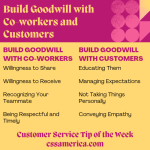
Build Goodwill with Co-workers and Customers - 11/10/26


All relationships are different.  We want to have good relationships with co-workers, after all – those are the people we spend the most time with each week.  We want to have good relationships with customers since they’re the ones that provide the revenue and inflows that allow us to Read more

How to Avoid “Groundhog Day” - 11/3/26


It’s Groundhog Day, where you’re living the same day over and over and over again. You have heard basically the same complaint from 4 different customers in the past week.  The bill is incorrect or confusing, and you’re having to spend a ton of time explaining things to the customer. You’ve Read more

Beware of Scary Telephone Customer Service - 10/27/26


As we near the Halloween holiday in the United States, it seems appropriate to discuss examples of scary customer service, particularly on the telephone.  Here are a few common issues that frustrate and annoy customers.  These are experiences to avoid delivering, and alternatives to adopt: The customer calls, describes their Read more

The Art of the Successful Script - 10/20/26


You’re the customer.  You go to the store, and they ask if you have a loyalty card.  You call the doctor’s office, and they ask for your birth date.   You walk up to the counter, and they ask if you found everything you were looking for. These are all valid Read more

The Key Building Block for Your Customer Relationship - 10/13/26


An automotive manufacturer gets supplies for their vehicles from all over the world.  They have arrangements, service level agreements, expectations for timing and quality of all the parts.  And when they gather all these supplies, they assemble the cars.  They test the cars.  Then they take pictures of those Read more

Be Flexible to Fill the Gaps - 10/6/26


The non-profit has the expected challenges.  There are only 3 people in the organization, yet, they have the same responsibilities of a larger company.  They have to do finance, sales, marketing; they deliver their services to the community, and they need to keep a pulse on what’s going on Read more

Is This Good Customer Service? - 9/29/26


A friend of mine reached out to me recently as she waited for the electrical technician to show up at her house to do some minor repairs.  She had never worked with this company before, but they sent a text about the tech who was soon to arrive. The message Read more

Ownership when Fixing Others’ Errors - 9/22/26


We were conducting training with a client recently, and one of the participants, Jackie, is in a role in his organization where he goes out to the customer site to investigate issues, address customer complaints, and fix problems.  While he’s at the site, he often gets an earful from Read more

Why “No” is So Important - 9/15/26


The employee told the caller: “I don’t think that is possible.” The customer eventually hung up, and redialed to ask a different employee the same question. The employee responded to the customer: “That’s probably not the best way to do it.”  Then, the customer kept asking question after question, arguing Read more

It’s Not “You,” It’s “I” - 9/8/26


During a business writing course that I took years ago, the instructor had us write an e-mail.  I can’t recall if it was written to a co-worker or customer, but after writing this e-mail, she had us count every “I” and “You.”  We talked about how we need to Read more

Let Customer Service Crush the Stereotypes

Posted on in Government Please leave a comment

Ever since I was a little kid, on TV and the radio and from people talking, I heard stereotypes of “government workers.” The stereotypes were never very positive. They talked about the slow speed with which the employees did their work, the lack of passion and energy with which they communicated, and the low level of responsiveness.

But most of the folks that I and my company work with in government are not anything like those stereotypes.  Yet, it’s still interesting to see what those industry stereotypes have done to the perceptions of employees who work in that industry.  Employees in that industry are stereotyped as being non-responsive, lazy, slow, non-productive.

Those stereotypes come from perceptions that relate to characteristics of customer service. We believe that customer service at the highest level is comprised of two primary things:

  1. The Attitudes, Skills, and Knowledge of employees.
  2. The Processes within which the customers experience the business.

The stereotypes that I refer to relate to judgments and perceptions that residents have of the employee attitudes and processes at municipal governments and other state and federal government agencies. It’s amazing that those perceptions of negativity so often relate to the perceptions of the customer service.

In other words, what many customers perceive or believe about an industry or an individual organization are based on what they perceive of that industry’s or that organization’s customer service.

If you want to change the perception of your organization or your industry in your customer’s eyes, start by improving your customer service.


Keeping the Sports Fan – 1 at a Time

Posted on in Sports Please leave a comment

It’s not all about wins and weather.  Organizations in the world of professional sports who truly understand the impact of the fan realize that there are many drivers of attendance and season ticket holder retention beyond how many wins a team has or how the weather is that day (for you baseball and football teams).

Marketing may bring you into a business as a new customer, but after that, the relationship and affinity for the organization often take over – if the business is smart.  It costs a lot of money to execute all those marketing and sales strategies, and the reason why organizations often talk in terms of ROI is that there’s usually a lot of upfront “I”  that you need to get the return on as quickly as possible.  You don’t get that return if the fan only attends 2 games, if the season ticket holder cancels after 1 year, if a losing record for a season means an automatic loss of the customer.

Sports organizations need to – at the start of the new fan relationship – ask why the customer is now a customer…and why they might leave.  Finding those retention drivers is vital to any organization wanting success; even though marketers often think in terms of demographics and client types when marketing to large groups, customer retention experts think of what would keep Joe v. Mary v. Marco v. Terry.

When you think retention, think 1-on-1, develop relationships 1-on-1, serve your clients 1-on-1.  Because if it’s all about wins and weather, then to the staff on the business side of the organization, you have zero control.  But if it’s about the relationship and the retention driver, the communications and the caring, the impact on their business or their personal lives, then you on the business side of the organization have some control.

Keep the sports fan by knowing what you can control in the relationship with that customer – one customer at a time.


Seek to Understand

Posted on in Business Advice Please leave a comment

One of the best tips I can give anyone new to the world of customer service is to “seek to understand.” When you think of the phrase “seek to understand,” you realize that it focuses on one person trying to understand something else or trying to learn about someone else.

When you think about poor customer service, you think about somebody taking a complaint personally. If you take the complaint personally, you’re more focused on how this impacts you rather than seeking to understand how it impacts the other person. When you think of poor customer service, you think of an employee getting into an argument with a customer when it should be easy to avoid the argument. But it is difficult to get into an argument with another person if you are truly seeking to understand. Because seeking to understand focuses on learning from the other and rarely involves the negative emotions of anger or hostility. 

When you think about poor customer service, you think about an employee who is impatient or seems rushed. But people who seek to understand are patient, they try to learn about the other person and their situation. When you think about poor customer service, you think about the employee talking on their cell phone or who is ignoring the customer because of some personal conversation with a co-worker. But employees who seek to understand welcome opportunities to help customers with needs or issues, and they seek to understand what the specifics of those issues and needs are and how to address them.

When you think about poor customer service, you think about employees who do not understand their processes and who don’t understand their products. Employees who seek to understand try to learn what the processes are like so they can work with the customers in the processes. They try to learn what their products are all about so that they can effectively convey that information to the customers.

If you want one great overriding thought to help guide you through your day in serving your customers, Seek to Understand.

Interested in improving your company’s customer service?  See more information at:  http://www.cssamerica.com/