

Education

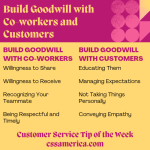
Build Goodwill with Co-workers and Customers - 11/10/26


All relationships are different.  We want to have good relationships with co-workers, after all – those are the people we spend the most time with each week.  We want to have good relationships with customers since they’re the ones that provide the revenue and inflows that allow us to Read more

How to Avoid “Groundhog Day” - 11/3/26


It’s Groundhog Day, where you’re living the same day over and over and over again. You have heard basically the same complaint from 4 different customers in the past week.  The bill is incorrect or confusing, and you’re having to spend a ton of time explaining things to the customer. You’ve Read more

Beware of Scary Telephone Customer Service - 10/27/26


As we near the Halloween holiday in the United States, it seems appropriate to discuss examples of scary customer service, particularly on the telephone.  Here are a few common issues that frustrate and annoy customers.  These are experiences to avoid delivering, and alternatives to adopt: The customer calls, describes their Read more

The Art of the Successful Script - 10/20/26


You’re the customer.  You go to the store, and they ask if you have a loyalty card.  You call the doctor’s office, and they ask for your birth date.   You walk up to the counter, and they ask if you found everything you were looking for. These are all valid Read more

The Key Building Block for Your Customer Relationship - 10/13/26


An automotive manufacturer gets supplies for their vehicles from all over the world.  They have arrangements, service level agreements, expectations for timing and quality of all the parts.  And when they gather all these supplies, they assemble the cars.  They test the cars.  Then they take pictures of those Read more

Be Flexible to Fill the Gaps - 10/6/26


The non-profit has the expected challenges.  There are only 3 people in the organization, yet, they have the same responsibilities of a larger company.  They have to do finance, sales, marketing; they deliver their services to the community, and they need to keep a pulse on what’s going on Read more

Is This Good Customer Service? - 9/29/26


A friend of mine reached out to me recently as she waited for the electrical technician to show up at her house to do some minor repairs.  She had never worked with this company before, but they sent a text about the tech who was soon to arrive. The message Read more

Ownership when Fixing Others’ Errors - 9/22/26


We were conducting training with a client recently, and one of the participants, Jackie, is in a role in his organization where he goes out to the customer site to investigate issues, address customer complaints, and fix problems.  While he’s at the site, he often gets an earful from Read more

Why “No” is So Important - 9/15/26


The employee told the caller: “I don’t think that is possible.” The customer eventually hung up, and redialed to ask a different employee the same question. The employee responded to the customer: “That’s probably not the best way to do it.”  Then, the customer kept asking question after question, arguing Read more

It’s Not “You,” It’s “I” - 9/8/26


During a business writing course that I took years ago, the instructor had us write an e-mail.  I can’t recall if it was written to a co-worker or customer, but after writing this e-mail, she had us count every “I” and “You.”  We talked about how we need to Read more

Own the Problem

Posted on in Business Advice, Education, Healthcare, Sports Please leave a comment

Personnel in a college athletics department were interviewed about the low attendance this season for basketball games. They discussed the reasons for it. ‘It’s the economy’s fault.’ Valid reason. But the student attendance is down, too. ‘It’s the players fault for not being more a part of the student body.’ Possibly valid. ‘It’s also the student leadership’s fault – they’re not doing a good enough job of getting the students excited about basketball.’ Possibly valid.

What’s interesting about these three reasons discussed is that none of them were the fault of the athletics department. Or put more politely, none of these were directly controllable by the athletics department.

So this implies one of two things. Either the athletics department has no impact whatsoever on attendance or they have an impact, but there’s nothing wrong with what they’re doing. They’re perfect.

This is the problem in organizations where the product is the most important thing. In sports, it’s the play on the court. In hospitals, it’s the clinical care. Too many people in these types of organizations feel that the product is not only the most important thing; it’s the only thing.

If this were true, why do athletics departments have “fan relations” positions? Why do pro sports team have “season ticket holder account representatives?” In hospitals, why are employees taught customer service skills?

Why? Because there should be some impact, some value, some effect from the efforts of these people.

If you’re in an industry where you don’t control the ultimate product, focus instead on what you DO control. And take more ownership over making an impact than did this one college athletics department.

Interested in improving your company’s customer service? See more information at: http://www.cssamerica.com/


Educate on Profits

Posted on in Business Advice, Education Please leave a comment

Peter Waller, Chief Executive Officer of Corinthian Colleges, was speaking about the recent performance of the organization in terms of its financials late last year (http://seekingalpha.com/article/186144-corinthian-colleges-inc-f2q10-qtr-end-12-31-09-earnings-call-transcript). And one of the key areas he addressed as a part of that discussion was the improvement in student satisfaction.

Before I go further, what this CEO did was to link (early on in his conversation) financial performance to student/customer satisfaction.

To put meat behind his belief in the cause/effect relationships between these two measures of performance, he noted several major initiatives focused on driving increases in student satisfaction such as: ‘Major increases in faculty development, increased investment in student services personnel, investments in new technology in the classroom, and increased wireless bandwidth at the campuses.’ He stated that "We will continue to focus on creating an outstanding experience to students at every campus and every program. We believe that if our students are satisfied and find value in our services; we will continue to grow and ultimately create value for shareholders."

This is a leader who understands the link between satisfaction and financial performance. He measures that link. He invests in those things which should drive up student satisfaction, knowing how that impacts business success. He gets it.

Many leaders discuss the importance of customer service. But do they measure it? Do they make strategic decisions which may – short-term – cost money or require resources? Do they change operations, processes, and people to improve student or customer satisfaction because they understand the link to profits?

If the answers in your organization are "No, No, and No," then your leaders may need to gain a better understanding of what truly drives long-term success.

Interested in improving your company’s customer service? See more information at: http://www.cssamerica.com/


Inquiring Educational Minds Want to Know

Posted on in Business Advice, Education Please leave a comment

The National Survey of Student Engagement (NSSE) conducts annual surveys of college and university students which address personal development, support from their faculty, and other factors driving student satisfaction.

The institutions are graded on such attributes as how supportive they are of student success, the promptness of feedback on student performance, rates of transfers in, etc.

So why is this information important? Isn’t this just another customer satisfaction survey? Sure it is, but this illustrates why such surveys are important. Students make their own decisions about staying or going, they offer word-of-mouth to friends and family about the institutions they attend, they decide whether to continue into graduate school there or to go elsewhere based in large part on their opinions of the institution.

Am I learning? Am I growing? Am I in a supportive environment? Am I being challenged to improve?

Any college or university can create the classes, the culture, and the campus they want. But at some point they have to assess if it’s the classes, the culture, and the campus that the STUDENTS want. At some point, they have to view the student as a customer, with needs and wants, preferences and priorities.

Surveys such as these create that opportunity for the student to be viewed as that important asset to the long-term success of the organization.

Now it’s just a matter on institutions acting on the information.

Interested in improving your company’s customer service? See more information at: http://www.cssamerica.com/