complaint | Customer Service Solutions, Inc. - Page 21

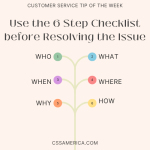
Use the 6 Step Checklist before Resolving the Issue - 4/28/26


We talk about trying to resolve the issue right the first time, sharing the technique on how to manage the conversation to get clarity on the real issue, need, or goal, and confirming your understanding before moving forward. But what are you trying to clarify?  What are you trying to Read more

Use the Customer’s Words - 4/21/26


The customer is describing a problem on what they call their “computer.” They mentioned that the “screen” doesn’t “move from one page to the other.” They say that the “website’s name is typed at the top,” and it says sample.com with a “line, and then it says ‘home’ after Read more

Affirming the Customer with Empathy - 4/14/26


We’ve spoken and written about empathy for the 20+ years of these customer service tips, noting empathy as the most important quality any individual can have if they want to be great at customer service.  We’ve shared that - in order to serve our customers most effectively – it’s Read more

The Power of Teaching While Helping - 4/7/26


If you’re trying to develop a relationship with the customer rather than just simply handling their transaction and moving on, you are taking a long-term view.  You realize that that individual is someone you want to keep with your business for months or years to come, so it’s a Read more

Bear with Me - 3/31/26


As a customer, you’ve probably called a company and heard the phrase “bear with me.”  At that point, you know there’s going to be some sort of delay.  The CSR is giving you a heads up that there’s going to be additional wait time.  Essentially, they are trying to Read more

Slowing Down the Fast Talker - 3/24/26


Jeffrey had always been told by his manager to figure out the issue quickly and wrap up the conversation as fast as possible.  So, Jeffrey was hyper-focused at finding that one key word that could identify the issue and help him to transition quickly to what might be some possible Read more

Don’t Bury the Lede - 3/17/26


Mary was working at the office, and she received an e-mail alert from the water company.  There was a water outage in her neighborhood.  It looked like it was going to be a couple hours to fix the issue. Sure enough, a few hours later around mid-afternoon, Mary received another Read more

Confirm the Real Issue Before You Start Solving - 3/10/26


Have you ever gone “down the rabbit hole?”  It involves going deep into some topic, some discussion – with analysis that creates complexity as much as it resolves it.  And that dive into the rabbit hole often starts with a simple question. Going down that rabbit hole takes time and Read more

One Question to Prevent a Follow-up Call - 3/3/26


The way some performance metrics work, you would think companies would prefer for their staff to talk to the same customer 4 times on the same topic for 8 minutes each rather than talking to them once for 10 minutes.  Many management metrics are too focused on average length Read more

Stay Calm When the Customer Isn’t - 2/24/26


There are all sorts of others’ emotions that you have to deal with as a customer service professional.  The other person could be anxious or upset, they could be angry or agitated.  It can run the gamut of emotions, but for you to deal with them in the best Read more

Govern Strategically for Great Customer Service

Posted on in Business Advice, Government Please leave a comment

When working with a government agency recently, we were planning to customize customer service training content for them. During the course of the training development interviews we conducted, it became clear that customer service training had never been done before at the agency. Customer service skills were not addressed in the organization’s hiring processes. Customer service was not part of the organization’s reward system, and customer service only briefly appeared on the staff performance evaluations.

Yet, management sincerely stated that customer service was important. It was important that customers were treated with respect, that the residents felt they were important, that upset customers got their issues addressed professionally, and that staff could appropriately address each customer based on that unique customer’s characteristics and needs.

So why was there the disconnect between management wanting to have great customer service and their doing what needed to be done to get great customer service?

Assuming the sincerity of the management team, the answer had to lie in the organization’s leaders not really knowing HOW to get great customer service. In the past, most businesses assumed that employees were generally nice, respectful, caring, and communicative people. Customer service is just common sense, and everybody knows how to deliver customer service, right? Those particularly assumptions were wrong then, and they’re REALLY wrong now.

For organizations to go from wanting great customer service to delivering great customer service, they need to understand strategically how to do so. It’s about the culture, the hiring, the training, the rewards, the accountability, the processes, the organization’s goals, the management team’s support and modeling of great customer service behaviors, and much more.

If you ever feel a disconnect between what your management says they want in customer service and what the organization actually delivers, have them take a step back, and start with a strategy.

Interested in improving your company’s customer service? See more information at: http://www.cssamerica.com/

Check out our new customer service book at http://www.amigreatat.com/


She’ll Take Your Order

Posted on in Business Advice, World of Customer Service Please leave a comment

There’s nothing like the feeling of comfort I get from a warm greeting at a business establishment. A feeling of "you are my most important customer" and "I cannot wait to serve you" brings a tear to the eye of a customer service consultant. But that’s not the only thing that can bring a tear to my eye.

Walking into a fast food restaurant, I stood back from the cashiers to determine what I wanted. After deciding, I walked to the counter and the two cashiers, both of which were available. This is how the conversation started:

Cashier #1: "Can I help…oh, she’ll take your order."

Cashier #2: "No, she’ll take your order."

Cashier #1: "No, she’ll take your order."

Cashier #2: "No…well, okay. What would you like?"

This dialogue would have been very flattering had they substituted "I" for "she," but the conversation made it obvious that, even though neither was doing anything, they’d prefer continuing to do nothing rather than help me buy their product.

Sometimes we complain about how many companies and many employees are more task-focused than customer-focused. But this company was more focused on inaction than action. While we desperately hope this experience is a rarity in your business, there are things to learn from the interaction that can help any business succeed.

First, hire people with not only the attitude of wanting to help others but also the energy to act on those impulses. Next, come up with a mantra that promotes productivity. One restaurant tells its staff to remember during slow times that "if you’re leaning (against the wall) you should be cleaning." Finally, create a proactive work environment. The more reactive a culture is, the more likely they are to be passive when there’s not a fire to fight. Proactive cultures promote the seeking of action and progress.

Work to create an atmosphere of "I’ll take your order."

Interested in improving your company’s customer service? See more information at: http://www.cssamerica.com/


To Streamline or To Serve? Yes, and Yes

Posted on in Business Advice, Government Please leave a comment

Many municipalities are taking on the dual goals of streamlining operations and improving customer service. It’s an interesting set of goals since so many people in business assume that improving customer service means adding people, adding services, and adding costs.

But customer service done right should facilitate cost reduction. It should do this primarily because of two different outcomes that effective customer service should achieve. The first is that improved customer service should reduce complaints and redundant contacts from customers. Processes are a huge part of customer service, and if the property bill is right, the resident is less likely to call to complain. If reserving the park shelter online worked, there is no need to place a complaint call to the municipality. If the caller calls in and gets to a person without an undue wait, they’re not going to abandon the call and make a second call. Doing things right the first time reduces contacts and other efforts that result from customer complaints.

The second way that great customer service facilitates cost reduction is that customer service done right implies having standardized and efficient processes which allow less room for individual employees to do things wrong, for errors to occur, for rework to be required. Customer service done right means that the self-service processes which customers use are simple, self-evident, timely, and attractive enough that the customer often prefers doing their own work over contacting an employee to do it for them.

Streamlining operations and improving customer service can co-exist…they SHOULD co-exist.

If your organization can do it right the first time, and if you can make your processes quick, simple, efficient, and high quality, you’ll notice customers are happier, and the workload will decrease.

It’s the win-win-win that customer, company, and employees all want.

Interested in improving your company’s customer service? See more information at: http://www.cssamerica.com/