

customer service

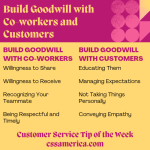
Build Goodwill with Co-workers and Customers - 11/10/26


All relationships are different.  We want to have good relationships with co-workers, after all – those are the people we spend the most time with each week.  We want to have good relationships with customers since they’re the ones that provide the revenue and inflows that allow us to Read more

How to Avoid “Groundhog Day” - 11/3/26


It’s Groundhog Day, where you’re living the same day over and over and over again. You have heard basically the same complaint from 4 different customers in the past week.  The bill is incorrect or confusing, and you’re having to spend a ton of time explaining things to the customer. You’ve Read more

Beware of Scary Telephone Customer Service - 10/27/26


As we near the Halloween holiday in the United States, it seems appropriate to discuss examples of scary customer service, particularly on the telephone.  Here are a few common issues that frustrate and annoy customers.  These are experiences to avoid delivering, and alternatives to adopt: The customer calls, describes their Read more

The Art of the Successful Script - 10/20/26


You’re the customer.  You go to the store, and they ask if you have a loyalty card.  You call the doctor’s office, and they ask for your birth date.   You walk up to the counter, and they ask if you found everything you were looking for. These are all valid Read more

The Key Building Block for Your Customer Relationship - 10/13/26


An automotive manufacturer gets supplies for their vehicles from all over the world.  They have arrangements, service level agreements, expectations for timing and quality of all the parts.  And when they gather all these supplies, they assemble the cars.  They test the cars.  Then they take pictures of those Read more

Be Flexible to Fill the Gaps - 10/6/26


The non-profit has the expected challenges.  There are only 3 people in the organization, yet, they have the same responsibilities of a larger company.  They have to do finance, sales, marketing; they deliver their services to the community, and they need to keep a pulse on what’s going on Read more

Is This Good Customer Service? - 9/29/26


A friend of mine reached out to me recently as she waited for the electrical technician to show up at her house to do some minor repairs.  She had never worked with this company before, but they sent a text about the tech who was soon to arrive. The message Read more

Ownership when Fixing Others’ Errors - 9/22/26


We were conducting training with a client recently, and one of the participants, Jackie, is in a role in his organization where he goes out to the customer site to investigate issues, address customer complaints, and fix problems.  While he’s at the site, he often gets an earful from Read more

Why “No” is So Important - 9/15/26


The employee told the caller: “I don’t think that is possible.” The customer eventually hung up, and redialed to ask a different employee the same question. The employee responded to the customer: “That’s probably not the best way to do it.”  Then, the customer kept asking question after question, arguing Read more

It’s Not “You,” It’s “I” - 9/8/26


During a business writing course that I took years ago, the instructor had us write an e-mail.  I can’t recall if it was written to a co-worker or customer, but after writing this e-mail, she had us count every “I” and “You.”  We talked about how we need to Read more

Making Student Retention a Real Focus

Posted on in Business Advice, Education Please leave a comment

Vincent Tinto, a Syracuse University professor, recently wrote a paper on Taking Student Retention Seriously. In the paper, he laments that most colleges/universities don’t take effective approaches to improving student retention. They too often think of a new program, a new activity, and a new offering to increase retention. Unfortunately, many of these new ideas result in “student experiences [which] are increasingly segmented into smaller and smaller pieces; their relationships with faculty, staff, and each other becoming more narrow and specialized; their learning further partitioned into smaller disconnected segments.”

So what does Tinto recommend? He suggests the need to create these 5 conditions which are supportive of Student Retention:

  • When students are expected to succeed, they are more likely to succeed. Success leads to retention.
  • When students are provided clear and consistent communications about requirements and advising on how to progress toward their goals, they are more likely to succeed.
  • When students receive “academic, social and personal support,” they are more likely to stay.
  • When students are involved “as valued members of the institution,” they are more likely to stay.
  • When students are in “settings that foster learning,” they are more likely to succeed and stay.

Tinto focuses on getting at the root cause of issues before defining the required action plans. But many organizations – when faced with customer or employee (or student) retention issues – often jump from symptom-to-solution. They offer the next great idea du jour…and hope it works.

Try to avoid jumping from symptom-to-solution. If you’re having student/customer/employee retention issues, get to the root cause first.

Find what makes students stick with you.

Check out our Education Industry Services: http://cssamerica.com/cssed.htm


Compassion and Customer Satisfaction

Posted on in Business Advice, Healthcare Please leave a comment

We always say that the 3 Drivers of Customer Satisfaction in ANY business are the Attitudes/skills/knowledge of employees, the service delivery Processes, and the Products themselves. And if you begin digging deeper into the components of Attitude, Process, and Product, you realize that Attitudes and Processes are what make up the Customer Service portion of overall Customer Satisfaction. And when you dig deeper into the Attitude piece itself, you realize that this means different things to customers of different industries.

For example, a recent study showed that the aspect of Attitude that is most important to cancer patients is compassion. More than any aspect of the Processes or Products/Services received experienced by the cancer patients as well, having “a compassionate team of care providers…access to a knowledgeable, competent physician…and…being treated as human beings…are the most important correlates with patient satisfaction.”

Why is this important to know? When you think of the hundreds of interactions that a patient and their family may have with employees and physicians on the phone, face-to-face, and via e-mail over the course of an inpatient stay and soon thereafter, when you think about all the processes the patients experience, and when you think of all the services provided to them, it’s a daunting task to try to improve EVERYTHING to have a positive impact on patient satisfaction.

Instead, if a hospital knows the primary drivers of patient satisfaction, it gives them a focus, a “bang-for-the-buck” improvement strategy, and a way to get everyone to rally around a particular aspect of the patient experience.

So think about this for your business as well. Don’t feel the need to try to improve EVERYTHING. We work with many clients including hospitals to identify – in a precise and quantitative fashion – just this: What are the 1 or 2 or 3 aspects of the customer experience with the most significant impact on their willingness to recommend you to others or to return themselves?

Find the “compassion” correlation that applies to your business and your customers.

Interested in improving your company’s customer service? See more at… http://www.cssamerica.com/


Would Poor Customer Service Make You Run for Office?

Posted on in Business Advice, Government Please leave a comment

The article Livingston County registrar of deeds faces ‘rude’ challenge notes how a Michigan resident decided to run in an election for the Register of Deeds for Livingston County because – as part of the reason – the customer service in the department is terrible. Staff are “definitely rude,” according to the candidate.

It’s interesting to read the article because – in order to get votes – this individual is attacking the very people she would be leading. It’s also interesting that the incumbent defends herself by talking about all the process improvements she made without addressing any efforts she made to ensure that the staff themselves are customer service-oriented (i.e., to ensure they’re NOT rude).

If I tried to run for office or (for private sector companies) take over every organization that provided poor customer service, I’d be taking over a whole lot of businesses. So I’m not suggesting that what this one resident is doing is a path that must be taken, but here’s what I am suggesting.

The two candidates – in total – are correct. Customer service is about employee attitudes, processes, systems, and communications. Improving customer service is about addressing those items, but it’s also about other things.

It’s about helping the customer to help themselves. It’s about trying to determine why you get repetitive questions and determining how to reduce those questions through improved customer education. It’s about learning why you get complaints, determining root causes, and not getting those same complaints again.

Learn a little lesson from this Michigan election. Customer service is important; it could cause the incumbent their job. It could propel an outsider into a new position.

So if it’s so important, know how to manage the demand for customer service, and get into continuous improvement mode.

Listen to our latest podcast episode of “Stepping Up Service” on The MESH Network at http://themesh.tv/stepping-up-service/