
mccc

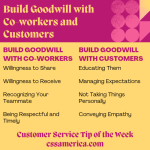
Build Goodwill with Co-workers and Customers - 11/10/26


All relationships are different.  We want to have good relationships with co-workers, after all – those are the people we spend the most time with each week.  We want to have good relationships with customers since they’re the ones that provide the revenue and inflows that allow us to Read more

How to Avoid “Groundhog Day” - 11/3/26


It’s Groundhog Day, where you’re living the same day over and over and over again. You have heard basically the same complaint from 4 different customers in the past week.  The bill is incorrect or confusing, and you’re having to spend a ton of time explaining things to the customer. You’ve Read more

Beware of Scary Telephone Customer Service - 10/27/26


As we near the Halloween holiday in the United States, it seems appropriate to discuss examples of scary customer service, particularly on the telephone.  Here are a few common issues that frustrate and annoy customers.  These are experiences to avoid delivering, and alternatives to adopt: The customer calls, describes their Read more

The Art of the Successful Script - 10/20/26


You’re the customer.  You go to the store, and they ask if you have a loyalty card.  You call the doctor’s office, and they ask for your birth date.   You walk up to the counter, and they ask if you found everything you were looking for. These are all valid Read more

The Key Building Block for Your Customer Relationship - 10/13/26


An automotive manufacturer gets supplies for their vehicles from all over the world.  They have arrangements, service level agreements, expectations for timing and quality of all the parts.  And when they gather all these supplies, they assemble the cars.  They test the cars.  Then they take pictures of those Read more

Be Flexible to Fill the Gaps - 10/6/26


The non-profit has the expected challenges.  There are only 3 people in the organization, yet, they have the same responsibilities of a larger company.  They have to do finance, sales, marketing; they deliver their services to the community, and they need to keep a pulse on what’s going on Read more

Is This Good Customer Service? - 9/29/26


A friend of mine reached out to me recently as she waited for the electrical technician to show up at her house to do some minor repairs.  She had never worked with this company before, but they sent a text about the tech who was soon to arrive. The message Read more

Ownership when Fixing Others’ Errors - 9/22/26


We were conducting training with a client recently, and one of the participants, Jackie, is in a role in his organization where he goes out to the customer site to investigate issues, address customer complaints, and fix problems.  While he’s at the site, he often gets an earful from Read more

Why “No” is So Important - 9/15/26


The employee told the caller: “I don’t think that is possible.” The customer eventually hung up, and redialed to ask a different employee the same question. The employee responded to the customer: “That’s probably not the best way to do it.”  Then, the customer kept asking question after question, arguing Read more

It’s Not “You,” It’s “I” - 9/8/26


During a business writing course that I took years ago, the instructor had us write an e-mail.  I can’t recall if it was written to a co-worker or customer, but after writing this e-mail, she had us count every “I” and “You.”  We talked about how we need to Read more

Transferring to a Competitor Can Mean Success

Posted on in Business Advice, Education Please leave a comment

There are not many industries where transferring a customer to a competitor is considered the right thing to do. There are even fewer where encouraging a customer to go to a competitor is common. And even less frequent than both of those occurrences is where one organization plans for a customer to leave them after a couple years to go to a competitor.

Now we’re not talking about a typical competitive relationship in this case; here, we’re talking about community colleges and 4-year universities. Where community colleges and universities often do compete for students, more and more universities are suggesting to some students to consider the community college route and transfer to a university after two years.

But the situation we’re describing in this post is where the community college – from Day 1 – should begin helping students to think longer-term – Where are you going after the second year here? What can we do in 2-3 years at our community college to get you positioned for an effective transfer to a 4-year university?

In the article MCCC Boasts High Student Transfer Rate, Monroe County Community College was recognized by CNNMoney for its high student transfer rate. That’s right…community colleges are considered successful if they transfer a high rate of students to a four-year institution. This Student Success-related metric is becoming more discussed and more used in determining future funding of community colleges. It’s because the educational system as a whole is being encouraged to better utilize community colleges as a lower cost way of getting (or at least) beginning a process toward a degree.

Beginning with the end in mind is not just good Covey phrasing. If community colleges want to be successful, they have to proactively work with students to create a plan to achieve that higher ed vision. They have to help individual students to understand what needs to be done in year one at the community college to graduate from the University in year four or five.

It’s not simply about getting the student admitted, getting them registered, or getting them into a program (and those processes aren’t often “simple” anyway). It’s about viewing each student as an individual, understanding their vision (or helping them create one), and – even when that vision goes beyond the college to the university – getting them on track to succeed.

Know if the Vision is the Transfer.

Learn about our CSS Education services at: http://cssamerica.com/cssed.htm

Interested in improving your educational organization’s customer satisfaction? See our other blog posts at: http://serviceadvice.cssamerica.com/category/education/