retention

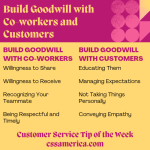
Build Goodwill with Co-workers and Customers - 11/10/26


All relationships are different.  We want to have good relationships with co-workers, after all – those are the people we spend the most time with each week.  We want to have good relationships with customers since they’re the ones that provide the revenue and inflows that allow us to Read more

How to Avoid “Groundhog Day” - 11/3/26


It’s Groundhog Day, where you’re living the same day over and over and over again. You have heard basically the same complaint from 4 different customers in the past week.  The bill is incorrect or confusing, and you’re having to spend a ton of time explaining things to the customer. You’ve Read more

Beware of Scary Telephone Customer Service - 10/27/26


As we near the Halloween holiday in the United States, it seems appropriate to discuss examples of scary customer service, particularly on the telephone.  Here are a few common issues that frustrate and annoy customers.  These are experiences to avoid delivering, and alternatives to adopt: The customer calls, describes their Read more

The Art of the Successful Script - 10/20/26


You’re the customer.  You go to the store, and they ask if you have a loyalty card.  You call the doctor’s office, and they ask for your birth date.   You walk up to the counter, and they ask if you found everything you were looking for. These are all valid Read more

The Key Building Block for Your Customer Relationship - 10/13/26


An automotive manufacturer gets supplies for their vehicles from all over the world.  They have arrangements, service level agreements, expectations for timing and quality of all the parts.  And when they gather all these supplies, they assemble the cars.  They test the cars.  Then they take pictures of those Read more

Be Flexible to Fill the Gaps - 10/6/26


The non-profit has the expected challenges.  There are only 3 people in the organization, yet, they have the same responsibilities of a larger company.  They have to do finance, sales, marketing; they deliver their services to the community, and they need to keep a pulse on what’s going on Read more

Is This Good Customer Service? - 9/29/26


A friend of mine reached out to me recently as she waited for the electrical technician to show up at her house to do some minor repairs.  She had never worked with this company before, but they sent a text about the tech who was soon to arrive. The message Read more

Ownership when Fixing Others’ Errors - 9/22/26


We were conducting training with a client recently, and one of the participants, Jackie, is in a role in his organization where he goes out to the customer site to investigate issues, address customer complaints, and fix problems.  While he’s at the site, he often gets an earful from Read more

Why “No” is So Important - 9/15/26


The employee told the caller: “I don’t think that is possible.” The customer eventually hung up, and redialed to ask a different employee the same question. The employee responded to the customer: “That’s probably not the best way to do it.”  Then, the customer kept asking question after question, arguing Read more

It’s Not “You,” It’s “I” - 9/8/26


During a business writing course that I took years ago, the instructor had us write an e-mail.  I can’t recall if it was written to a co-worker or customer, but after writing this e-mail, she had us count every “I” and “You.”  We talked about how we need to Read more

Why Train to Retain in BRE…

Posted on in Business Advice, Government Please leave a comment

The University of Tennessee has created a course called “Business Retention and Expansion in Tennessee.” While that’s not the most creative course name (kind of like my company, Customer Service Solutions, Inc. isn’t the most creative name…), it clearly indicates what this course addresses – retention and growth of your existing businesses. The course touts statistics such as “79 percent of all new jobs in the state in 2009 resulted from the expansion of existing business and industry.” That stat could apply to most any business – most of your revenue comes from existing clients.

So economic development organizations should have strategies, research, and training to be intentional about that business retention and job growth. Unfortunately, many communities make assumptions about retention such as:

· “We have no control over whether businesses stay or leave, whether they expand here or elsewhere.”

· “Nobody would leave our community.”

· “If there was an issue, the business leader would call me.”

· “I know everybody and everything going on in the community; so I’ll know if there’s something that’s an issue to a local business.”

These are all assumptions – assumptions that can get a community in trouble. And these assumptions apply to anybody who is managing accounts just like BRE representatives manage relationships with multiple local employers.

You have to believe you can make an impact. You have to understand that businesses might leave. You have to be proactive and not assume that businesses are going to contact you in time to help them. And you cannot assume you know all that’s going on in your local businesses.

Local economic development agencies need training and guidance in how to build relationships with local employers, how to proactively reach out to them, how to respond when needs and issues arise, and how to grow their jobs base.

Don’t make assumptions about retention and growth. Get the training, research, and strategy development you need to succeed.

Read our New Book – “Ask Yourself…Am I GREAT at Customer Service?” http://www.amigreatat.com/

Listen to our latest podcast episode of “Stepping Up Service” on The MESH Network at http://themesh.tv/stepping-up-service/

Interested in improving your company’s customer service? See more at our new website! http://www.cssamerica.com/


Create a Custom Retention Toolkit

Posted on in Business Advice, Sports Please leave a comment

In the article Marketing starts with customer service, the author promotes the concept of identifying the 20% of your customers that drive the majority of your business. Then market to them and provide them with stellar service. The idea is to have a targeted marketing approach for your top existing customers just as you would to a target demographic (using more typical marketing parlance).

Later in the article, the different marketing strategies are referred to as retention tools…hmmm…interesting.

It’s interesting because many of us think about customer service as responding to requests, as resolving issues, as anticipating customer needs. But from a retention standpoint, what collateral (or to use the author’s term), what tools do employees at your company have available to them to keep and grow business with existing customers?

Remember from our other blog posts that retention is different from marketing in that retention needs to be more personalized – more 1-to-1 based on the customer’s true renewal drivers. But once you know those drivers for your key client types, you may find consistencies such that a high percentage of customers will stick with you for a few key reasons.

In pro sports, the teams often offer many benefits to customers, but we’ve surveyed enough season ticket holders (STHs) to know that those benefits are rarely the reason why the STH renews are not. So don’t come up with a laundry list of benefits; again, be targeted.

If the retention driver is “being in the know” with your company’s latest product offerings or events or initiatives, possibly have an “Insider” newsletter that only the best customers receive before the general public – it could include a personalized letter from the CEO. If the driver is quick turnaround on special orders, ensure you have a fast-track process for urgent orders available to key customers. If the driver is the relationship with the organization’s people, make sure the employees share their names, ask about the customer, give unsolicited tips on the use of the products or meeting other customer needs.

Identify reasons why your key customer types would stay or go, and then create your own retention toolkit.

Read our New Book – “Ask Yourself…Am I GREAT at Customer Service?” http://www.amigreatat.com/

Interested in improving your company’s customer service? See more at our new website! http://www.cssamerica.com/


Follow the Lead of Others in Retention and Growth

Posted on in Business Advice Please leave a comment

Here are a few recent key paragraphs in business articles:

“My three focuses are employee satisfaction, customer satisfaction and economic success.”

“Hallmarks of the quarter included significant loan and deposit growth, evidence of the success that sales and customer retention initiatives are having.”

“Financial services executives searching for creative and inexpensive customer retention programs…”

Clients can “benefit from…increased revenue through improved customer retention.”

The product “enables managers to improve customer retention and profitability.”

The theme? The tie between customer retention and financial performance. Some of these organizations are creating structures to support customer retention like a “Retention Team” that identifies high-priority at-risk clients and works to retain them. Other organizations are launching incentives with staff and customers alike that promote retention. Still other organizations are implementing what CSS calls a “Customer Relationship Development” strategy to learn customer retention drivers and retain/grow the customer base.

What all these organizations know is that there needs to be a focus and structure around customer retention. When you ask most organizations what they do to retain customers, they point to having a good experience during the sale or having a call center to handle complaints, but both of these are reactive and transactional.

What is your organization doing that is more proactive and relationship-oriented? Do you have a criteria for identifying at-risk clients or customer types? Do you have a proactive method of communicating with customers even when a transaction is not occurring? Is that method personalized and direct? And what is the organization doing to create the supporting staffing structures and incentive plans that promote an organizational alignment tying Mission, Vision, and Financial Performance to Customer Retention efforts?

Challenge your organization and its leadership to make the changes necessary to succeed in retention and growth.

Read our New Book – “Ask Yourself…Am I GREAT at Customer Service?” http://www.amigreatat.com/

Interested in improving your company’s customer service? See more at our new website! http://www.cssamerica.com/