wait | Customer Service Solutions, Inc. - Page 7

Finalize the Solution with the 6 Step Checklist - 5/5/26


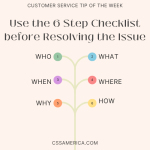
In last week’s Tip, we showed why and how to Use the 6 Step Checklist before Resolving the Issue.  We noted the importance of taking 15 seconds to mentally walk through the Who, What, When, Where, Why, and How to feel confident that you know what’s needed to fix Read more

Use the 6 Step Checklist before Resolving the Issue - 4/28/26


We talk about trying to resolve the issue right the first time, sharing the technique on how to manage the conversation to get clarity on the real issue, need, or goal, and confirming your understanding before moving forward. But what are you trying to clarify?  What are you trying to Read more

Use the Customer’s Words - 4/21/26


The customer is describing a problem on what they call their “computer.” They mentioned that the “screen” doesn’t “move from one page to the other.” They say that the “website’s name is typed at the top,” and it says sample.com with a “line, and then it says ‘home’ after Read more

Affirming the Customer with Empathy - 4/14/26


We’ve spoken and written about empathy for the 20+ years of these customer service tips, noting empathy as the most important quality any individual can have if they want to be great at customer service.  We’ve shared that - in order to serve our customers most effectively – it’s Read more

The Power of Teaching While Helping - 4/7/26


If you’re trying to develop a relationship with the customer rather than just simply handling their transaction and moving on, you are taking a long-term view.  You realize that that individual is someone you want to keep with your business for months or years to come, so it’s a Read more

Bear with Me - 3/31/26


As a customer, you’ve probably called a company and heard the phrase “bear with me.”  At that point, you know there’s going to be some sort of delay.  The CSR is giving you a heads up that there’s going to be additional wait time.  Essentially, they are trying to Read more

Slowing Down the Fast Talker - 3/24/26


Jeffrey had always been told by his manager to figure out the issue quickly and wrap up the conversation as fast as possible.  So, Jeffrey was hyper-focused at finding that one key word that could identify the issue and help him to transition quickly to what might be some possible Read more

Don’t Bury the Lede - 3/17/26


Mary was working at the office, and she received an e-mail alert from the water company.  There was a water outage in her neighborhood.  It looked like it was going to be a couple hours to fix the issue. Sure enough, a few hours later around mid-afternoon, Mary received another Read more

Confirm the Real Issue Before You Start Solving - 3/10/26


Have you ever gone “down the rabbit hole?”  It involves going deep into some topic, some discussion – with analysis that creates complexity as much as it resolves it.  And that dive into the rabbit hole often starts with a simple question. Going down that rabbit hole takes time and Read more

One Question to Prevent a Follow-up Call - 3/3/26


The way some performance metrics work, you would think companies would prefer for their staff to talk to the same customer 4 times on the same topic for 8 minutes each rather than talking to them once for 10 minutes.  Many management metrics are too focused on average length Read more

What it Means to Respect Someone’s Time – 10/22/19

Posted on in Customer Service Tip of the Week Please leave a comment

Whether it is with a client when I realize that the meeting might go long, or possibly it’s in a workshop where I’m trying to end one conversation so we can move on to the next topic, there is a phrase I’ve used many times, and I mean it sincerely: I want to be respectful of your time.

Time is a valuable commodity. In this world that we live in, people are often so busy, they feel like they don’t have time, and maybe they truly don’t in that moment. One thing is for sure, whether people truly have time or not, they don’t want to feel like their time is being wasted. So, as someone who works in customer service, how do you respect someone’s time?

Look at it through the lens of the acronym BDA. BDA stands for Before, During, and After.

When you first engage a customer, thank them for the time they spent Before they got to you. Particularly if this is a follow-up question or request of theirs, or if they drove to your location, say Thanks for coming in! Show appreciation for what they went through prior to coming to you. Oftentimes you’re having a 2-minute conversation face-to-face with somebody who’s already accessed your website, called your co-worker, driven through rain and snow and gloom of night, and waited in line just to see you.

During refers to the conversation itself. Try to be as efficient as possible in meeting that customer’s needs; early on confirm how much time the customer has so that you know if they have 2 minutes or 20 minutes to sit with you. By understanding what’s going on in their mind from a time perspective – by knowing whether they are rushed or relaxed – you can best value their time in that interaction.

After refers to thinking about what’s going to happen next. If they have a next step that they need to take, or if there’s going to be some delay in your follow-up because of some internal process or communication or decision that needs to be made, let them know that you appreciate the forms they will be filling out. Let them know you appreciate their patience as they wait for an answer or resolution to their question.

To show that you value someone’s time, to be respectful of someone’s time, engage the customer with your understanding of what time they put into this interaction Before, During, and After.

Signup for FREE Tips!    Contact Us    More Resources for You    Visit Our Home Page


Back to Reality…for Customer Expectations – 7/30/19

Posted on in Customer Service Tip of the Week Please leave a comment

Have you ever walked into a patient registration area of a hospital and seen a sign that said “if you’ve been waiting longer than 15 minutes, please see the receptionist?”

Have you ever called a customer service number and been told by a recording that “the average hold time is ‘X’ minutes?”

Have you ever begun the process of getting a permit to build a deck on a home and been given a form that says what each step in the process involves, when you need to do each step (including inspections), and whom you need to contact?

You may reply “no” to all of these or “yes” to some, but these are examples of companies who understand the importance of trying to set or manage customer expectations. These companies understand that that first person may complain after waiting 5 minutes if they don’t realize that a 15-minute wait is realistic. These companies realize that that second customer may get irate or take their business elsewhere if they had to wait on the phone 2 minutes but might be more patient if their expectation is a 3-minute wait. These companies understand that a customer educated on a process is more comfortable and less likely to have issues with it, less likely to do things incorrectly.

Companies who attempt to proactively set or manage expectations understand the importance of the customer having some concept in their mind of what the reality is going to be; that makes it more likely that the customer will be satisfied with the experience, and the employee won’t have to deal with an irate customer.

Where can your company proactively set an expectation with customers about how long a process will take, how long a wait might be, what actions are about to take place, or what they need to do?

Determine where the opportunities to set expectations exist, and then use signage, messaging, documentation, and direct one-on-one conversations to do whatever you can to set (or reset) your customers’ expectations.

Get customer expectations back to reality.

Signup for FREE Tips!    Contact Us    More Resources for You    Visit Our Home Page


To Banter or Not to Banter – 5/12/15 TOW

Posted on in Customer Service Tip of the Week Please leave a comment


I love some good banter or chit-chat – it’s great for informal conversations with friends, family and co-workers. But when is it great for customer conversations?

First, let me define “Banter” in a customer context. Think of it as conversation about a topic that most likely has little to do with the customer’s need, issue, or question. You’re initiating a discussion about nothing pertinent to the conversation (e.g., Where are you calling from? Where did you get that beautiful bracelet? The weather has been crazy this year here, hasn’t it?).

So why would you ever have some light-hearted banter with the customer? There are many times:

  • When there’s downtime during the call – You want to keep the conversation going.
  • When the customer is NOT irate or angry – It’s too risky when they have that negative emotion to go off-topic – that may upset them unless you’re REALLY talented at defusing those emotions.
  • When you’re trying to learn more about them – You’re trying to show interest in them as an individual customer.
  • When it’s the beginning of the relationship – You want to know them better to serve them better.
  • When they clearly have time – Banter is more readily accepted by those more likely to be patient (not in a rush).
  • When they have NOT been waiting long – It takes time to banter – see their situation before bringing up other topics.
  • When you’re doing a task (on the computer, etc.) where they are waiting for your process to end – They won’t feel it’s a waste of time if they can tell that you’re still being productive.
  • When you’re trying to reduce the perception of wait time (such as a long stay in a waiting room) – It shows that you noticed them and are aware of them despite the fact that no service is being performed at that moment.

 
Banter? Chit-chat? Sure. Just be smart about when you do it.

Signup for FREE Tips!    Contact Us    More Resources for You    Visit Our Home Page