
Customer Service Tip of the Week

Giving Thanks for You - 11/24/26


This is Thanksgiving time in the United States, so it’s definitely a time to pause to intentionally appreciate others.  And when it comes to our world - the world of customer service - I just want to let you know how much I appreciate you, and people who are Read more

Ensure Customers Can Expect the Expected - 11/17/26


When Maria calls her local pharmacy with a question, she knows to press 1 on the menu, and one of the pharmacy techs will pick up within 5-10 seconds. When she walks into the pet store, she knows that somebody’s going to greet her in the first 2-3 seconds, asking Read more

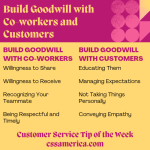
Build Goodwill with Co-workers and Customers - 11/10/26


All relationships are different.  We want to have good relationships with co-workers, after all – those are the people we spend the most time with each week.  We want to have good relationships with customers since they’re the ones that provide the revenue and inflows that allow us to Read more

How to Avoid “Groundhog Day” - 11/3/26


It’s Groundhog Day, where you’re living the same day over and over and over again. You have heard basically the same complaint from 4 different customers in the past week.  The bill is incorrect or confusing, and you’re having to spend a ton of time explaining things to the customer. You’ve Read more

Beware of Scary Telephone Customer Service - 10/27/26


As we near the Halloween holiday in the United States, it seems appropriate to discuss examples of scary customer service, particularly on the telephone.  Here are a few common issues that frustrate and annoy customers.  These are experiences to avoid delivering, and alternatives to adopt: The customer calls, describes their Read more

The Art of the Successful Script - 10/20/26


You’re the customer.  You go to the store, and they ask if you have a loyalty card.  You call the doctor’s office, and they ask for your birth date.   You walk up to the counter, and they ask if you found everything you were looking for. These are all valid Read more

The Key Building Block for Your Customer Relationship - 10/13/26


An automotive manufacturer gets supplies for their vehicles from all over the world.  They have arrangements, service level agreements, expectations for timing and quality of all the parts.  And when they gather all these supplies, they assemble the cars.  They test the cars.  Then they take pictures of those Read more

Be Flexible to Fill the Gaps - 10/6/26


The non-profit has the expected challenges.  There are only 3 people in the organization, yet, they have the same responsibilities of a larger company.  They have to do finance, sales, marketing; they deliver their services to the community, and they need to keep a pulse on what’s going on Read more

Is This Good Customer Service? - 9/29/26


A friend of mine reached out to me recently as she waited for the electrical technician to show up at her house to do some minor repairs.  She had never worked with this company before, but they sent a text about the tech who was soon to arrive. The message Read more

Ownership when Fixing Others’ Errors - 9/22/26


We were conducting training with a client recently, and one of the participants, Jackie, is in a role in his organization where he goes out to the customer site to investigate issues, address customer complaints, and fix problems.  While he’s at the site, he often gets an earful from Read more

Some Customers LOVE Predictability – 9/30/25

Posted on in Customer Service Tip of the Week Please leave a comment

I was facilitating focus groups of businesses that utilize local government services.  The phrase that popped up multiple times was “Time Is Money!”  What these municipal customers were conveying was that their time was valuable, and delays were wasting their time.  But the conversations were not just about how long some process would take.  These were builders and developers, these were representatives of organizations that were performing renovations and repairs.

While the total process time was one part of the timeliness equation, one of my learnings from these focus groups was that the other part of the timeliness equation was predictability.

These focus group participants evaluated the customer experience by having an understanding of what that experience was going to be, the milestone dates or timelines associated, and those expectations being met.

The Customer’s Need for Predictability

The customers needed predictability because it enabled them to plan their next steps and timeframes.  It enabled them to understand how the tasks they’re working on fit into the bigger picture schedules.  It helped them to communicate with their stakeholders about timelines and responsibilities.

This also applies to healthcare.  If somebody is having an outpatient procedure, knowing the length of the procedure, how long they’ll be held after the procedure, how much notification lead-time they’ll get before they get discharged – that knowledge helps the patient to understand when to make that call for transportation to take them home.

This applies to pro sports.  We do TONS of surveys for pro sporting events, and sometimes fans reach out to us directly – not about the survey but asking when they’re going to get their tickets for the next event.  They were not told what to expect or didn’t remember, and now they’re antsy because the expectations aren’t known, because the predictability isn’t there.

What this Means for You

When considering how to improve your customer experience, focus on how to improve the predictability of what you do.  Oftentimes there is a predictable nature to what the process steps might be, who’s going to follow-up with the customer, and when it’s going to occur.  But unless that is communicated to the customer, and unless that is delivered as designed, the customer won’t know what to expect.  The lack of predictability can create additional touch points for you and additional anxiety for the customer.

Create more predictability for a better customer experience.

Signup for FREE Tips!    Contact Us    More Resources for You    Visit Our Home Page


Find Your Special Sauce – 9/23/25

Posted on in Customer Service Tip of the Week Please leave a comment

When I watch a football game and I see a great quarterback (somebody who may be considered a “Star”), he might be an excellent runner, have a big arm, be able to diagnose the defense and get his team into the right play.  But he’s likely not great at everything.  Mistakes occur, interceptions are thrown, there are times when he passes and should have run…and vice versa.

I am wowed by musicians – people who can make incredible music on a guitar.  People who can play 10 different songs on a piano at the drop of a hat during a church hymn sing.  Great drummers who can somehow wield two sticks on drums and symbols while also using their feet to bang the bass drum.  But unless you’re a 1-man band (or Prince!), you’re probably not great at all those instruments.  While you may be great at playing instruments, you may not be the best singer or lyricist.

My point is that stars are stars for what they do, but that doesn’t mean that they are great at everything.

Defining Stardom

I’m sure if you’re reading this tip and you’re in a customer service role, you’re either a customer service star already or you have the capacity to become a star.  Now whether you’re that star athlete or that star musician or that star customer service professional, find your special sauce – those 1 or 2 things where you’re already greater or have the capacity to be greater, and continually strengthen it.

Define YOUR Stardom

Become a star because you know how to calm those irate customers.  Become a star because you have an incredible depth of knowledge about your organization’s products, policies, processes, and people.  Hone your skills as a star in how you engage people with your body language and your tone and how you can read others and – on the fly – adjust your communication approach to meet what will work best with them.

In this day and age, it is way too UNcommon for people to be stars in business writing, to be able to craft communication pieces and e-mails that convey the specific information, make the other person feel heard, and create clarity in a concise manner on what the next steps are, when they’ll happen, and who’s responsible.

Hone your star skills for teamwork.  Not only supporting your teammates but understanding your specific role on the team and learning how to strengthen the traits that make you such an important member of your group.

Be a customer service star by understanding what is unique about you and what you bring to the organization, to the team, to the customer.  Then make a conscious effort to build your star talents, attitudes, and attributes.

Become a Customer Service Star.

Signup for FREE Tips!    Contact Us    More Resources for You    Visit Our Home Page


Gain Control of the Conversation – 9/16/25

Posted on in Customer Service Tip of the Week Please leave a comment

The customer’s angry or upset or they have a complaint.  They’re very chatty or very wordy or they just want to talk to somebody.  You’re on a time crunch, and the customer obviously is not.

There are times when you need to gain control of the conversation.  It’s important for you to do so.  But it’s equally important to understand the difference between controlling the conversation and controlling the customer.

Don’t make it your goal to control the customer.  You have enough to worry about with reading your own emotions and controlling your own reactions and being deliberate in what you say and how to say it.

It’s tough enough to weave in all your knowledge and all the different options and alternatives and all of your experience in order to help the customer without having to figure out how to control the customer.

The Goals

Gaining control of the conversation is something you do to bring the emotional level down, to focus the conversation, to shorten the time you’re engaged with the customer.

With those goals in mind, let’s describe the difference between controlling the conversation and controlling the customer.

How to Gain Control

Controlling the conversation results from asking questions, particularly more closed-ended questions – the yes or no variety, the fact or figure variety.  Controlling occurs when you can intentionally and concisely make a point.  When you can segue from something they say to the decision you need to make.  It’s when you can take their broad ramblings, and get them to focus on a specific piece of information on a worksheet or on your computer.  It’s when you get to the point where you can make the next steps clear and confirm their understanding and agreement.

The next time you’re dealing with that customer who’s upset, or they lack focus, or they want to talk for a long time when you’re more time-constrained, don’t try to control the customer.  Focus on guiding the discussion to an end point.

Gain Control of the Conversation.

Signup for FREE Tips!    Contact Us    More Resources for You    Visit Our Home Page