

customer experience

Ensure Customers Can Expect the Expected - 11/17/26


When Maria calls her local pharmacy with a question, she knows to press 1 on the menu, and one of the pharmacy techs will pick up within 5-10 seconds. When she walks into the pet store, she knows that somebody’s going to greet her in the first 2-3 seconds, asking Read more

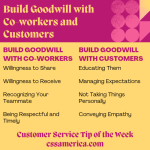
Build Goodwill with Co-workers and Customers - 11/10/26


All relationships are different.  We want to have good relationships with co-workers, after all – those are the people we spend the most time with each week.  We want to have good relationships with customers since they’re the ones that provide the revenue and inflows that allow us to Read more

How to Avoid “Groundhog Day” - 11/3/26


It’s Groundhog Day, where you’re living the same day over and over and over again. You have heard basically the same complaint from 4 different customers in the past week.  The bill is incorrect or confusing, and you’re having to spend a ton of time explaining things to the customer. You’ve Read more

Beware of Scary Telephone Customer Service - 10/27/26


As we near the Halloween holiday in the United States, it seems appropriate to discuss examples of scary customer service, particularly on the telephone.  Here are a few common issues that frustrate and annoy customers.  These are experiences to avoid delivering, and alternatives to adopt: The customer calls, describes their Read more

The Art of the Successful Script - 10/20/26


You’re the customer.  You go to the store, and they ask if you have a loyalty card.  You call the doctor’s office, and they ask for your birth date.   You walk up to the counter, and they ask if you found everything you were looking for. These are all valid Read more

The Key Building Block for Your Customer Relationship - 10/13/26


An automotive manufacturer gets supplies for their vehicles from all over the world.  They have arrangements, service level agreements, expectations for timing and quality of all the parts.  And when they gather all these supplies, they assemble the cars.  They test the cars.  Then they take pictures of those Read more

Be Flexible to Fill the Gaps - 10/6/26


The non-profit has the expected challenges.  There are only 3 people in the organization, yet, they have the same responsibilities of a larger company.  They have to do finance, sales, marketing; they deliver their services to the community, and they need to keep a pulse on what’s going on Read more

Is This Good Customer Service? - 9/29/26


A friend of mine reached out to me recently as she waited for the electrical technician to show up at her house to do some minor repairs.  She had never worked with this company before, but they sent a text about the tech who was soon to arrive. The message Read more

Ownership when Fixing Others’ Errors - 9/22/26


We were conducting training with a client recently, and one of the participants, Jackie, is in a role in his organization where he goes out to the customer site to investigate issues, address customer complaints, and fix problems.  While he’s at the site, he often gets an earful from Read more

Why “No” is So Important - 9/15/26


The employee told the caller: “I don’t think that is possible.” The customer eventually hung up, and redialed to ask a different employee the same question. The employee responded to the customer: “That’s probably not the best way to do it.”  Then, the customer kept asking question after question, arguing Read more

Why are they Calling You? – 7/29/14 TOW

Posted on in Customer Service Tip of the Week Please leave a comment


The customers were complaining about being transferred multiple times, about voice messages not being returned, about e-mails they sent that received no response.

Then the company responded with solutions.

The staff needed to be more responsive. The staff needed training. The company needed a new policy. A monitoring system for staff responsiveness needed to be put into place.

The scenario I just described happens thousands of times per day across the customer service landscape, and it happened recently to me as well with one of our clients.

However, there’s an inherent problem with this scenario. Too often, the focus is ONLY on how to respond better, more quickly, and more consistently.

The bigger question, the root cause question is this – Why is the customer calling in the first place?

Is it a complaint about a defective product? If so, then why is the company selling defective products?

Is the question about poor customer service? Then why is the service so poor?

Is the call requesting a status update? Then isn’t there another way for the customer to get a status without calling?

Is the contact made by the customer so they fully understand the next steps? If so, then why weren’t those next steps conveyed clearly, simply, and in a documented manner already?

I would never advise any company NOT to try to improve. But before you try to address issues of responsiveness, find out the reasons you’re having to respond in the first place. Then find ways to reduce the need for the customer to call you directly.

Know why they are calling you.

Signup for FREE Tips!    Contact Us    More Resources for You    Visit Our Home Page


Review the Failures of Others to Ensure Success – 7/22/14 TOW

Posted on in Customer Service Tip of the Week Please leave a comment


“Those who don’t learn from history are doomed to repeat it.”

Many people have said variations of this – from George Santayana to Lemony Snicket – and I’m saying it today because it reminds me of a question I was asked recently.

A French financial services firm interviewed me about customer service and client retention for their internal publication. One of the questions addressed the many seemingly excellent customer service strategies and initiatives that don’t work. Essentially, why do they fail?

Here are four key reasons I provided:

  • Leadership Doesn’t Really Buy-In – Although leaders may talk about the importance of customer service and the client experience, they make decisions based on the product, they create incentives focused on new sales only, they sign-off on strategies that focus purely on reducing cost per unit. They talk the customer service talk, but their structures and incentives don’t align with service and retention goals. Here’s an example if you haven’t heard the recent Comcast customer retention call?
  • The Company Doesn’t Dedicate Resources – While an organization may care about the customer, if there’s no designated individual, division, strategy, or budget that focuses on service and retention, it won’t work. Sustaining an organization-wide effort is impossible if the initiative is 5% of the jobs of many without ever being the totality of the job of at least a few people in the organization.
  • The CX Definition is Limited – A small business owner laughed at me once when I brought up the concept of Internal Customers. He didn’t believe that employees should view and treat each other as customers. He didn’t believe that the customer experience (CX) applied to anyone within the corporate walls. He thought culture was irrelevant in driving a great service experience and retention. Zappos would disagree.
  • Tactic Supersedes Strategic – Too many companies conduct a survey, change a computer system, start a call center, send out memos telling staff to answer calls in 3 rings, and then expect their customer service scores and retention rates to jump off the charts. For organizations to be great at customer service, they need to view their organization as a system – where all the people, processes, programs, and technology interrelate and work for the good of the customer and company. Have a strategy for sustained service excellence and growth; tactics should then flow from that strategic view.

 
Align Around the Customer, Dedicate Resources, Look Within, and Think Strategically.

Ensure your organization doesn’t repeat the failures of business history.

Signup for FREE Tips!    Contact Us    More Resources for You    Visit Our Home Page


It’s Okay if You Don’t Know Anything about Tomatoes – 7/15/14 TOW

Posted on in Customer Service Tip of the Week Please leave a comment


Going to Otto’s Home Improvement to get an opinion on a tomato – it shouldn’t be an aggravating experience. But for Lance, it resulted in a nail-on-the-chalkboard (do they still have chalkboards?) feeling.

Lance’s wife was growing tomatoes on the back deck, and several tomatoes were growing quickly. Good news, right? Well there was a problem – the tomatoes were still green on top but becoming black underneath and starting to shrivel up.

Luckily Lance had a “go to” lady in the garden center at Otto’s, so he drove to the store seeking advice. He walked up to 4 staff chatting with each other at the garden center entrance and asked for the “go to” lady, but she was off that day.

So Lance showed a tomato to others and asked for advice. He was greeted by blank stares and no response for about 15 seconds. Then one employee walked up, took the tomato, looked closely, said “that’s a fungus,” and started walking.

Lance took off after the employee, and they walked into the store toward the outdoor chemicals. The employee stopped in front of the plant chemicals, started staring, and didn’t say a word. After about a minute of quiet staring, Lance asked “what are you looking for?”

“A green bottle,” was the reply.

“What is it?”

“I’m not sure, but it works.”

“What brand?

“I don’t know.” There was a long pause, and then the employee said “it’s not there; sorry.” He walked off.

Lance was able to grab the tomato before the employee walked away and then went home to his wife. The next day Lance’s wife took the tomato to another garden center, and the issue was a lack of calcium. The store sold her a spray to add calcium, and the tomatoes grew perfectly thereafter.

In the world of serving others, none of us are omniscient. We don’t know all, and that’s okay. In those times when we don’t know the answer, it’s okay to say “I don’t know,” but follow that up with “I’ll find out.” Take initiative on behalf of the customer, but don’t let that initiative lead you down a path of time wasted and misinformation. Admit the knowledge gap, and quickly move to get the answer.

It’s okay to say you don’t know anything about tomatoes.

Signup for FREE Tips!    Contact Us    More Resources for You    Visit Our Home Page