customer service | Customer Service Solutions, Inc. - Page 79

Confirm the Real Issue Before You Start Solving - 3/10/26


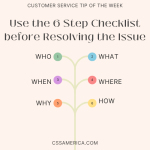
Have you ever gone “down the rabbit hole?”  It involves going deep into some topic, some discussion – with analysis that creates complexity as much as it resolves it.  And that dive into the rabbit hole often starts with a simple question. Going down that rabbit hole takes time and Read more

One Question to Prevent a Follow-up Call - 3/3/26


The way some performance metrics work, you would think companies would prefer for their staff to talk to the same customer 4 times on the same topic for 8 minutes each rather than talking to them once for 10 minutes.  Many management metrics are too focused on average length Read more

Stay Calm When the Customer Isn’t - 2/24/26


There are all sorts of others’ emotions that you have to deal with as a customer service professional.  The other person could be anxious or upset, they could be angry or agitated.  It can run the gamut of emotions, but for you to deal with them in the best Read more

Don’t Begin with the Dead End in Mind - 2/17/26


Habit #2 of Stephen Covey’s “Seven Habits of Highly Successful People” is “Begin with the End in Mind.”  It speaks to the need to have a clear vision or goal for what you’re trying to ultimately achieve, so you understand the purpose of what you’re doing.  It helps you Read more

Explain without Over Explaining - 2/10/26


The customer has a question, and we have an answer.  They need to learn something, and we’re in the position to be the educator.  There’s a process they have to go through, and we need them to understand. We know so much, and we could impart so much, but sometimes Read more

Look for a Stop Sign - 2/3/26


As a customer service professional, what you say matters.  The information you’re providing is useful.  The direction you’re giving the other person is helpful.  But... As you’re speaking, you also need to be reading.  Reading the other person.  Watching the customer, determining whether and how they’re receiving what you’re sharing.  Read more

When They Want the Supervisor - 1/27/26


Maybe you did your best with the customer, or maybe the customer didn’t even give you a chance.  They want to talk to your supervisor.  They see you, notice your title does not have “supervisor” or “manager” or “director” or “President and CEO” in it, so they want to Read more

Identify Your Point of Empathy - 1/20/26


I was watching a webinar recently on empathy.  The speaker mentioned that empathy - to a large extent - is something that you are born with.  It’s something that’s very difficult to learn.  And while I agree that some people are predisposed to being empathetic and understanding of others Read more

Pressure is a Privilege, but... - 1/13/26


When athletes are asked about the pressure of a playoff match or a late-game situation, many times they will say that “pressure is a privilege.”  In other words, usually pressure exists because you’re in a match that matters most.  It exists because you are a player put in a Read more

While I’ve Got You on the Phone… - 1/6/26


I’m a big planner.  Whether it’s strategic planning or planning out the year or planning my week first thing on a Monday morning, I like to plan.  I do this because it gets all of my action items documented and ensures that I have some understanding of what I Read more

Customerize Your Business – 8/25/15 TOW

Posted on in Customer Service Tip of the Week Please leave a comment


Most of us have seen flow charts. You document Step A followed by B followed by C. What does the employee do first? What report do they produce? To where do they route the call?

We’ve all seen e-newsletters that go out to customers. You share what you’re doing, note great offers, and pitch the latest product.

Everyone has gone to a business website. It says what we do, it’s organized by our products/industries, and it talks in the language to which we’re accustomed (I’m guilty of having “consultantese” throughout my site).

But what if we “customerized” our businesses? Let’s take a hospital. For processes, they might say – if a family member wants to visit the newborn baby, how would they want to find the hospital? What would they want the parking experience to be like? How would they want to find out where the relative is located and how they can find the baby? How would they want staff to greet them, and what would be the best exit experience?

Consider the sports team. They’re constantly sending out the marketing mailings to season ticket holders (STH), but what if they customerized the newsletters? Imagine Brian, the STH, getting an e-mail with a Subject heading identifying information about his favorite player. The body of his e-mail addresses only those things of interest to him – the kid’s club, his favorite visiting team coming to town, and a gift coming his way for his upcoming birthday. Brian’s e-mail is all about Brian, and the e-mail comes from his personal account representative, Marie.

If you work in a government organization, imagine having a website that’s been customerized. Instead of it being about government departments and services, it’s about the resident or business. Instead of the list of options including 38 departments and agencies, it lists common questions that the typical resident may ask. Instead of it listing 3 pages of detailed text instructions on how to appeal a tax bill or submit a plan to renovate a deck, it has a simple flow using customer terms and having graphics similar to most advanced websites nowadays.

To have the best experience for your customer, remove yourself from the internal focus of most companies. View your world through the eyes of the customer for the benefit of your customer.

Customerize Your Business.

Signup for FREE Tips!    Contact Us    More Resources for You    Visit Our Home Page


Rudeness is an Issue – How to Avoid it – 8/11/15 TOW

Posted on in Customer Service Tip of the Week Please leave a comment


According to a recent times.com article, there are several top reasons why customers get frustrated with customer service. Tied for the biggest frustration is dealing with rude customer service representatives. Survey results noted that 75% of customers are “highly annoyed by rude or condescending employees.”

While many of us feel that we’re generally pleasant people, even the most pleasant individuals can run the risk of coming off as rude or condescending. This perception by others can come from the tone of voice, the actual words used, or body language in face-to-face situations.

In order to ensure that the answer you give or solution provided does not reflect negatively on you, here are several things you can do to avoid being perceived as rude or condescending:

  • Watch Subtle (and sometimes not-so-subtle) Tone Issues – Avoid the “huffs” or frustrated sighs, and don’t let your booming voice dominate them.
  • Avoid Using “you” if Discussing Blame – Don’t do this: “If you would have just done ABC, this wouldn’t have been an issue.”
  • Convey Some Empathy – There’s a difference between a coldly delivered “That’s against policy” and an empathetic “Unfortunately we’re not able to do ABC for this reason, but let’s talk about what we CAN do for you.”
  • Effectively Move to the Hold or Transfer – Don’t put someone on hold or transfer unless you first ask and explain why you’re making the move.
  • Consider the Body Language – Avoid the eye rolls, folded arms, smirks, a lack of focus on the customer, and – ugh – putting your hand up in the “stop” position.
  • Don’t Rush the Customer – This is by far the most frequent cause of perceived rudeness – even when customers are dealing with kind customer service representatives. Lacking patience, talking quickly, giving short answers, interrupting the other person, and not confirming that the customer got their need met are all drivers of that perception of a rude employee.

 
Avoid rudeness – the customer’s hot button with customer service.

Signup for FREE Tips!    Contact Us    More Resources for You    Visit Our Home Page


I Know It When I See It – 7/28/15 TOW

Posted on in Customer Service Tip of the Week Please leave a comment

“I know it when I see it.”

In 1964, a United States Supreme Court justice used these words to determine whether a movie was an “obscenity” or not. He couldn’t define an obscenity with words, but he concluded that this particularly movie couldn’t be accurately described using that word (or other words the plaintiffs were using…).

It’s 51 years later, and for some reason that quote applies to a lot in life. Some things are hard to define, but you know it when you see it. Believe it or not, mediocre customer service is one of those things. I’m not talking terrible customer service – that’s typically easier to note than great customer service, but I’m talking about the little things that differentiate the below average from the above average, that differentiate the predictably poor from the predictably good, that differentiate those that don’t care from those that do care.

There is no perfection in life. There is no perfection in serving customers, either. It is as much an art as a skill or an attitude. It’s not pure science, but there are examples of that better interaction that show you that the person or the company got it right in customer service:

  • When the employee greets you they either stand or remain seated.
  • They either smile or they frown.
  • Either their eyes are engaged with you or distracted.
  • Either they face you or they don’t.
  • They either say “I’d be happy to help” or “no problem.”
  • When you turn in information, they either respond “that’s perfect,” or they don’t respond at all.
  • They either say “I’ll call you back,” or they say “you call me back.”
  • They either apologize for the company’s error, or they avoid the apology.
  • They either thank you for your time and question, or they end the call in silence.
  • Either they ask you questions, or they wait for you to ask them questions.
  • They either go to you, or they wait for you to go to them.
  • They either confirm what you need, or they assume it.
  • They either confirm you got the need met, or they move on to something else.

These examples don’t necessarily illustrate the “WOW!” moment, but they illustrate the little things that create consistent excellence.

When it comes to the consistently positive customer service experience, the customer knows it when they see it.

Signup for FREE Tips!    Contact Us    More Resources for You    Visit Our Home Page