empathy

Complement Empathy with Action - 8/4/26


A man falls into a hole, and he can’t get out.  He starts yelling for help, and a doctor walks by and looks down the hole.  The man in the hole yells to the doctor “Please help me.  I’ve fallen into this hole!”  And the doctor takes out a Read more

My 8-Minute Visit at the DMV- 7/28/26


I needed to get a Real ID, which in North Carolina facilitates airline travel and other identity verifications.  My wife suggested I go to one particular DMV that was a LONG way away from home, but where she had experienced great customer service.  I was lucky to find an Read more

When They Might Walk Out the Door…Permanently- 7/21/26


Have you ever had one of those conversations with the customer where they literally tell you they’re about to stop doing business with your company?  This is it.  They may bring up a competitor or found another way to get their need met, or they are just leaving. When we Read more

Transparency in Customer Service- 7/14/26


We’ve worked with a lot of clients in the local government sector, and many of these clients have Customer Service Standards and/or corporate values that include Transparency. Think about an old-fashioned transparency sheet, that malleable see-through page you put on an overhead projector.  You can see everything on one side Read more

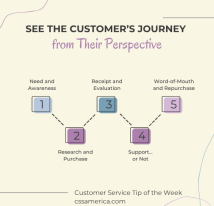
See the Customer’s Journey from Their Perspective- 7/7/26


That customer is face-to-face with you right now, and you are fielding their questions or delivering your service to them.  And oftentimes and understandably, we are so immersed in the moment that we don’t think about what came before or think enough about what comes next. But in the life Read more

Gaining the Benefits of the Greeter- 6/30/26


Most likely, we’ve all entered some establishment – a retail store, restaurant, or service center - when there is a greeter at the door.  The most famous greeter position is probably the Walmart greeter.  I often thought that my father-in-law would have been a fantastic Walmart greeter, because he Read more

Seamlessness - Why the Customer Thanked You - 6/23/26


This doesn’t happen enough nowadays, but the employee received a long thank you e-mail from the customer.  A financial services account manager had taken care of the client during a period of time that was stressful for the customer. Life was unexpectedly changing quickly, and personal emotions, additional financial responsibilities, Read more

When to Avoid the Escalation - 6/16/26


The customer calls with a complaint, and the easy thing to do is to escalate it to your supervisor. That may also be the right thing to do, but how do you know when to avoid the escalation? Why You Would Escalate The first thing to consider is why you would Read more

Let’s be Clear on Clarity - 6/9/26


When trying to manage expectations, it’s vital to be clear with the customer.  But what specifically does it mean to be “clear?” Clarity is in the eyes and ears of the beholder, so what may be clear to one customer may be unclear to another.  However, there are some basic Read more

Allow Yourself to Solve a Couple Puzzles Every Day - 6/2/26


Frank had never been a dog owner before, and when he first got Bosco at the shelter, Frank didn't really know what he was doing.  He would try to be a good parent - feed the dog, play with it, take it on walks - but he was doing Read more

I Assume She is Not Like Me – 3/4/14 TOW

Posted on in Customer Service Tip of the Week Please leave a comment


She left me a voice mail, and I prefer to respond via e-mail. She talks really fast, and I prefer a more casual speed. What she wants most is to be heard, and what I want most is to have my problem fixed. She wants to be walked through a process by an employee, and I want the self-service option.

She is the customer. I am the employee. We could not be more different.

But what if I prefer voice mail, I talk fast, I want to be heard, and I want that 1-on-1 employee support? Then we’re the same, correct?

The point is not in the determination of whether we’re the same or different. The point is that we can’t make assumptions that we and the customers are the same.

How I prefer to be communicated with, how I prefer a situation be handled, how I prefer to get a need met may be the same as 70% of my customers, but what about the other 30%? If I believe that they are like me, I could deliver some pretty lousy service to those 30%.

This is when we talk about the importance on not assuming the customer is just like us. This is when trying to convey empathy is so important. Because customers want their need or issue addressed, but many also want it addressed in a certain manner, and if we don’t take the initiative to identify not only what they want but how they want it received or handled, we could have a dissatisfied customer.

Don’t just describe what you’ll do for the customer, but confirm that will work. Don’t just assume how you’ll communicate with them, but ask their preference. Don’t just overlook the particulars of their situation, ask them for the details.

To deliver great customer service, we have to avoid the assumption they are like us and – instead – confirm the reality. Assume they’re different; that focus will force you to ask them about themselves, their needs, their issues, and their preferences. It will put you in a learning mindset, and it will make you better at serving them in the best manner possible.

Assume the customer is different from you.


Convey Compassion in Customer Service – 8/13/13 TOW

Posted on in Customer Service Tip of the Week Please leave a comment

The hospital promoted the 3 C’s: Compassionate Competent Care. The Care was what they provided – patient care, clinical care. Competent denoted that there was quality to what they provided. Compassionate signified. . .well. . .compassion.

So what is “Compassion” in customer service, and how does it apply even outside of healthcare?

There are several definitions of compassion, but the overriding one that applies to customer service is “sympathy, empathy, and concern for others, particularly for their issues or misfortune.” Customers want you to care for them, particularly when they’re in a tough situation. So you want to be compassionate.

Based on this definition of compassion, ask yourself a few questions. Are you aware of the customer’s issues? Are you understanding of their misfortunes? And just as importantly, how do you convey your understanding and concern?

There are ways to convey compassion with your words/phrases. Use these words frequently in dialogue with the customer to convey compassion for their issue/misfortune:

  • “Your issue” or “Your concern”
  • “You” used in a personal reference
  • “I understand”
  • “I care”
  • “I’m sorry”
  • “I’m concerned.”

What aspects of body language and tone of voice convey compassion?

  • Offer a gentle touch on the back or shoulder
  • Provide eye contact
  • Periodically nod your head
  • Acknowledge/engage the customer and their family/friends
  • Sit/kneel to customer’s eye level
  • Lean toward the customer rather than away or toward the door
  • Use a more quiet tone
  • Avoid utterances while customer is talking.

To be compassionate, use the words and non-verbal communications that convey you care.

Convey Compassion in Customer Service.


Analyze This… – 7/2/13 TOW

Posted on in Customer Service Tip of the Week Please leave a comment

No we’re not talking about the Robert De Niro movie. I’m going to give you a real world situation, and I want you to analyze the customer service of this employee – Frank the building inspector.

Frank looked at his list of inspections for the day and cringed at the first one on the list. “What a way to start the day,” he murmured. “Waynesville Brothers Contracting. I can’t stand those guys. They’re always trying to get away with stuff. Drives me crazy.”

As Frank started out to the job site, he grew more irate about the conversation he anticipated having. When he got there to do the inspection, the site manager was a new guy named Pete. Frank immediately went up to Pete and introduced himself by name. Pete responded “it’s good to meet you.” Frank responded gruffly, “I won’t be here long hopefully. I’ll let you know what I find out.”

Soon Frank started the inspection, and as was usually the case with Waynesville Brothers Contracting, he found lots of issues. But for a first inspection, it wasn’t quite as bad as normal. When he went back to Pete, he interrupted Pete’s discussion with a subcontractor and said, “I’m ready when you are to go over this stuff.”

Pete asked “How did we do?,” and Frank responded “let me go through the list – there’s several items to address.”

As they walked through the items, Pete asked several questions. Whereas he was an experienced manager, he had moved to the East Coast within the past year from the Midwest, and he wasn’t as familiar with the State code. When Frank realized this, he slowed down on his review of the items, and he clearly stated why some of the items were in violation of code.

At the end, Frank said, “do you have any more questions, Pete?” Pete said “Nope, I’ve got it.” Frank said, “then let me give you a number to call and a website when you’re ready to schedule the re-inspection.” After providing the information, Frank said, “good to meet you. Have a good one,” and he left.

Now for the analysis. . .

What did Frank do right? What did Frank do wrong? Analyze Frank’s mindset, his terminology, his probable tone of voice, his assumptions, his use of personal names, and his general way of interacting.

While I’m sure you did a great job in analyzing Frank, it’s not always as easy to analyze ourselves. . .but we need to do so. To get better, we have to know the starting point – how we’re doing today.

So analyze yourself after you have a customer interaction. Try to do this at least once per day – particularly with conversations that you can tell – in your gut – did not go well. Ask “What did I do well?” and “What could I have done better?”

To improve, know your starting point. Analyze yourself.