sports

It’s Not “You,” It’s “I” - 9/8/26


During a business writing course that I took years ago, the instructor had us write an e-mail.  I can’t recall if it was written to a co-worker or customer, but after writing this e-mail, she had us count every “I” and “You.”  We talked about how we need to Read more

It Shouldn’t Make a Difference, But… - 9/1/26


We have this conversation with lots of our sports clients, but the principles apply across all different industries.  Too many service representatives view a conversation with a customer as a transaction.  Just get him off the phone as quickly as possible.  The customer is Joe Public, not Joseph Pendergrass.  Read more

Use What the Customer Gives You - 8/25/26


Scenario #1: The customer sent an e-mail to the general inbox at the company.  The message noted that the customer needed to get a family member added to their account, but they couldn’t tell from the website how to do so. The next morning an employee opened up the e-mail, Read more

How Better Customer Service is Better for You - 8/18/26


Oftentimes, we have employees in training or workshops who really want to understand what’s in it for them to deliver better customer service.  How does the employee benefit from a better customer experience? Noted below are 5 different aspects of a great experience desired by the customer.  What if... The customer Read more

Manage New Customer Expectations - 8/11/26


The fan had never been to a motorsports event before, but they had been to concerts.  They had been to big conferences.  At those other events, they could park right next to the venue, many of the activities were indoors, and weather was a non-issue.  So, they were not Read more

Complement Empathy with Action - 8/4/26


A man falls into a hole, and he can’t get out.  He starts yelling for help, and a doctor walks by and looks down the hole.  The man in the hole yells to the doctor “Please help me.  I’ve fallen into this hole!”  And the doctor takes out a Read more

My 8-Minute Visit at the DMV- 7/28/26


I needed to get a Real ID, which in North Carolina facilitates airline travel and other identity verifications.  My wife suggested I go to one particular DMV that was a LONG way away from home, but where she had experienced great customer service.  I was lucky to find an Read more

When They Might Walk Out the Door…Permanently- 7/21/26


Have you ever had one of those conversations with the customer where they literally tell you they’re about to stop doing business with your company?  This is it.  They may bring up a competitor or found another way to get their need met, or they are just leaving. When we Read more

Transparency in Customer Service- 7/14/26


We’ve worked with a lot of clients in the local government sector, and many of these clients have Customer Service Standards and/or corporate values that include Transparency. Think about an old-fashioned transparency sheet, that malleable see-through page you put on an overhead projector.  You can see everything on one side Read more

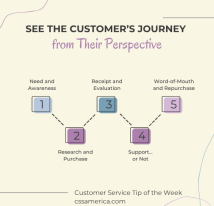
See the Customer’s Journey from Their Perspective- 7/7/26


That customer is face-to-face with you right now, and you are fielding their questions or delivering your service to them.  And oftentimes and understandably, we are so immersed in the moment that we don’t think about what came before or think enough about what comes next. But in the life Read more

It Shouldn’t Make a Difference, But… – 9/1/26

Posted on in Customer Service Tip of the Week Please leave a comment

We have this conversation with lots of our sports clients, but the principles apply across all different industries.  Too many service representatives view a conversation with a customer as a transaction.  Just get him off the phone as quickly as possible.  The customer is Joe Public, not Joseph Pendergrass.  The customer is generic, not unique individually.  This is a transaction, not anything more.

In sports, we look at that customer – that account holder whose ticket for an individual basketball game might cost $100.  But the average account has 2.5 tickets.  There are 41 home games in the season, and the average account lasts for 5.3 years.  So, we can view that conversation as a generic customer or a $100 ticket, or we could realize that the lifetime value of the relationship with the person I’m speaking with is $54,325.

We’re working in the water utility call center, and somebody is calling in to ask how to use our ePortal, or they’re complaining about a high bill.  We noticed that their average bill is $75.  We could view this person as somebody who is asking a question we’ve gotten 100 times, we’re just trying to give them the standard response.  Or we can realize that the average homeowner will end up living in our community for close to 30 years.  Therefore, in today’s dollars, that $75 monthly bill equates to an account worth $27,000.

It shouldn’t matter whether this is a $100 ticket or a $54,000 account.  It shouldn’t matter whether this is a $75 invoice or a $27,000 account.  But for many of us, it does matter.

For many of us in customer service, it affects our mindset.  If we go into every interaction just viewing this as a transaction or somebody asking me a question or presenting me with an issue, it can feel routine, not interesting or unique, and sometimes that indifference in our mind can come across as indifference in our tone of voice and interaction with that customer.

So, it’s sometimes beneficial to get that phone call from the season ticket holder, and realize this is somebody who has $54,000 in value in ticket purchases alone.  It’s beneficial to think about this water utility customer as somebody who is contributing $27,000 to the municipality.

It shouldn’t matter, but sometimes it helps to get us in the right mindset when we see the true lifetime value of the customers we serve.

Signup for FREE Tips!    Contact Us    More Resources for You    Visit Our Home Page


Don’t Skip the Recap – 5/12/26

Posted on in Customer Service Tip of the Week Please leave a comment

The playoff hockey game goes on for almost 3 hours.  There’s non-stop action, with plenty of penalties and takeaways and hits against the boards…and a few goals, as well.

You didn’t get to watch the whole game because you had other plans, but you wanted to know what happened.  So, you pull up a summary online and scan through the article.  In a minute, you’ve gotten a good feel for the ebbs and flows of the game, you know who won, and you know when the next game is going to be held and where it will be televised.

In the world of customer service, the recap helps here, too.  We might have a customer conversation that lasts 2 minutes or 25.  I had an online chat recently that lasted an hour.  It was as painful as it was long.

And none of us can be expected to remember every detail of every conversation, nor does that serve a great purpose.  But in the world of customer service, if we’re going to spend this much time with the customer, if we’re going to hear all the questions and concerns, if we’re going to do all the investigation, if we’re going to map out what happened and why, what needs to go next and when, then it helps to close with a recap.

What are those 2-3 key takeaways?  What are the key next steps?  What’s the timeline that both you and the customer need to be aware of and committed to?

As a customer service professional, our interpretation of everything that happened during that conversation might differ from the customer’s interpretation.  Are we clear on the customer’s details?  Are they clear on our answers to their questions?

We don’t want a difference of interpretation, misunderstood points, unanswered questions to result in a difference of understanding about what’s going to happen next and when it’s going to happen.

Take time at the end of the conversation and confirm the key points, particularly those that are upcoming.

Don’t skip the recap.

Signup for FREE Tips!    Contact Us    More Resources for You    Visit Our Home Page


Look for a Stop Sign – 2/3/26

Posted on in Customer Service Tip of the Week Please leave a comment

As a customer service professional, what you say matters.  The information you’re providing is useful.  The direction you’re giving the other person is helpful.  But…

As you’re speaking, you also need to be reading.  Reading the other person.  Watching the customer, determining whether and how they’re receiving what you’re sharing.  And sometimes if you’re really watching the customer – their behaviors, their expressions – you can read their signs, and sometimes the signs say STOP.  They say PAUSE.  They say LET THEM TALK.

When you’re sharing something with the customer or you’re talking to them, and they are flipping through their paperwork or scrolling the phone for some information, they’re not paying attention.  That’s a Stop Sign.

When they look at the clock or their watch, or their eye contact strays elsewhere, that’s a Stop Sign.

When you can tell they’re trying to talk or convey some information or physically moving in such a way that they’re about to burst unless they get their turn to speak, that’s a Stop Sign.

When the brow gets furrowed, like they’ve just been asked to lay out a blueprint for World Peace or provide the algorithm that Google uses to prioritize web searches, they may be unclear or confused.  That’s a Stop Sign.

At this point, it’s not about what we’re saying, it’s about how we’re listening to their body language.  It’s how we’re focused on how they’re receiving or not receiving our message, how they’re paying or not paying attention.

Sometimes the best thing to do in a conversation with a customer is to know when to stop speaking and ask them about their thoughts, or ask if they have something to share, or ask if anything is unclear.

 Look for a Stop Sign.

Signup for FREE Tips!    Contact Us    More Resources for You    Visit Our Home Page


1 2 3 4 5 6 7 8 9 10 ... 17 18   Next »