
phrases

Ensure Customers Can Expect the Expected - 11/17/26


When Maria calls her local pharmacy with a question, she knows to press 1 on the menu, and one of the pharmacy techs will pick up within 5-10 seconds. When she walks into the pet store, she knows that somebody’s going to greet her in the first 2-3 seconds, asking Read more

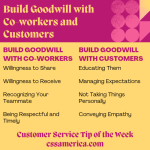
Build Goodwill with Co-workers and Customers - 11/10/26


All relationships are different.  We want to have good relationships with co-workers, after all – those are the people we spend the most time with each week.  We want to have good relationships with customers since they’re the ones that provide the revenue and inflows that allow us to Read more

How to Avoid “Groundhog Day” - 11/3/26


It’s Groundhog Day, where you’re living the same day over and over and over again. You have heard basically the same complaint from 4 different customers in the past week.  The bill is incorrect or confusing, and you’re having to spend a ton of time explaining things to the customer. You’ve Read more

Beware of Scary Telephone Customer Service - 10/27/26


As we near the Halloween holiday in the United States, it seems appropriate to discuss examples of scary customer service, particularly on the telephone.  Here are a few common issues that frustrate and annoy customers.  These are experiences to avoid delivering, and alternatives to adopt: The customer calls, describes their Read more

The Art of the Successful Script - 10/20/26


You’re the customer.  You go to the store, and they ask if you have a loyalty card.  You call the doctor’s office, and they ask for your birth date.   You walk up to the counter, and they ask if you found everything you were looking for. These are all valid Read more

The Key Building Block for Your Customer Relationship - 10/13/26


An automotive manufacturer gets supplies for their vehicles from all over the world.  They have arrangements, service level agreements, expectations for timing and quality of all the parts.  And when they gather all these supplies, they assemble the cars.  They test the cars.  Then they take pictures of those Read more

Be Flexible to Fill the Gaps - 10/6/26


The non-profit has the expected challenges.  There are only 3 people in the organization, yet, they have the same responsibilities of a larger company.  They have to do finance, sales, marketing; they deliver their services to the community, and they need to keep a pulse on what’s going on Read more

Is This Good Customer Service? - 9/29/26


A friend of mine reached out to me recently as she waited for the electrical technician to show up at her house to do some minor repairs.  She had never worked with this company before, but they sent a text about the tech who was soon to arrive. The message Read more

Ownership when Fixing Others’ Errors - 9/22/26


We were conducting training with a client recently, and one of the participants, Jackie, is in a role in his organization where he goes out to the customer site to investigate issues, address customer complaints, and fix problems.  While he’s at the site, he often gets an earful from Read more

Why “No” is So Important - 9/15/26


The employee told the caller: “I don’t think that is possible.” The customer eventually hung up, and redialed to ask a different employee the same question. The employee responded to the customer: “That’s probably not the best way to do it.”  Then, the customer kept asking question after question, arguing Read more

Use the 6 Step Checklist before Resolving the Issue – 4/28/26

Posted on in Customer Service Tip of the Week Please leave a comment

We talk about trying to resolve the issue right the first time, sharing the technique on how to manage the conversation to get clarity on the real issue, need, or goal, and confirming your understanding before moving forward.

But what are you trying to clarify?  What are you trying to confirm?

Sometimes we might miss information without even realizing it, so we’re going to go to an old standby which only takes you 15 seconds to mentally walk through; use this as a 6 Step Checklist before moving on to resolve the issue.  Ensure you’ve identified the Who, What, When, Where, Why, and How.

Who was involved in this situation?  Along with the customer, was anybody associated with the customer, or were any of your co-workers or other stakeholders involved?  Your path to resolution can easily be impacted if a certain co-worker had their hand in the process, or if there were more people involved than you were originally thinking.

What happened?  Be clear on the details of the specific issue or situation that occurred.

When did it happen?  Sometimes you can tell a lot if they called after hours, they walked in first thing in the morning, they tried to access a website on the weekend, or they referenced their account early in the morning.

Where did it happen?  Your business may have 5 offices in the region, and they all do things a little bit differently – some better than others.  Sometimes the location even within a given facility sheds light on what the concern was or what could have been some potential causes.

Why is this person standing in front of you?  Why did this issue raise itself to the level of an in-person visit, or a phone call, or an e-mail being sent to your inbox?  Is this a 1-time occurrence, or is this just the proverbial straw that broke the camel’s back?

How did this happen?  Try to understand the steps in the process that led to the issue.  Maybe the customer didn’t take a step that was expected, or a return call never happened, or a wait time was long, or it was an issue with paperwork not the mobile app.

Get the full picture of what happened when you try to find the solution.  Take 15 seconds, and make sure you understand Who, What, When, Where, Why, and How.

Use the 6 Step Checklist before resolving the issue.

Signup for FREE Tips!    Contact Us    More Resources for You    Visit Our Home Page


Use the Customer’s Words – 4/21/26

Posted on in Customer Service Tip of the Week Please leave a comment

The customer is describing a problem on what they call their “computer.” They mentioned that the “screen” doesn’t “move from one page to the other.” They say that the “website’s name is typed at the top,” and it says sample.com with a “line, and then it says ‘home’ after the line.”

They noted how they’re clicking on “the screen,” but the page doesn’t change.  They try to go “backwards” by clicking the “arrow pointing left,” and nothing happens.

This is a customer calling a technology help desk, and they’re using their words to describe their problem.

Oftentimes, customer service professionals are so knowledgeable about their products and services, their policies and processes, that they carry on a conversation with a customer, responding with terms common to the employee without realizing the audience.

We will talk about devices, monitors, URLs.  We will reference browsers and tabs, icons and more technical terms.  But if we hear the customer using certain terms – even if they are not the technical term WE use – we need to realize something.  If we want to add clarity and bring information to the customer in a manner of speaking that they understand, it’s often best to use THEIR words.

I’m not suggesting that we condescend or talk down to the customer.  I’m saying that the goal is for us to understand each other, and it’s more likely if we – the professional – change on the fly to use terms they’re familiar with than if we try to make them technical experts.  We’ve been trained for years on our technical terminology, so we can’t expect the customer to learn our wording in the matter of a 3-minute conversation.

To enhance the tone of the conversation and create some clarity for the customer at the same time, use their words.

Signup for FREE Tips!    Contact Us    More Resources for You    Visit Our Home Page


Affirming the Customer with Empathy – 4/14/26

Posted on in Customer Service Tip of the Week Please leave a comment

We’ve spoken and written about empathy for the 20+ years of these customer service tips, noting empathy as the most important quality any individual can have if they want to be great at customer service.  We’ve shared that – in order to serve our customers most effectively – it’s vital to have a desire to convey understanding of the other person – what is unique about them and their situation.

And usually when we discuss phrasing that conveys empathy, it relates to your sharing statements like “I can see how ABC can be frustrating” or “I can understand how XYZ could be upsetting.”  You are intellectually conveying an understanding of their feelings, of their position in the matter.

When they share their story, their situation, their challenging emotions, there are other ways you can convey – even more concisely and more simply – some empathy:

“That makes total sense” or “Definitely understandable” or “I get it” or “I understand.”

You’re saying these things with a nodding of the head, with a manner of speaking and a tone of voice that convey warmth and patience.

Even the most simple of “Yes, Sir” and “Yes, Ma’am” in response to those customer comments affirms them, offers empathy.

In these concise examples of empathy, without much being conveyed in your words specifically about their situation, you have to be more conscious of your body language, tone, and focus.  Those communication tools take on greater importance in ensuring you’re conveying affirmation of the person, even if you’re not necessarily agreeing with any points that may be unfounded or untrue. 

When you’re trying to deliver great customer service, empathy is a must, but that doesn’t mean you have to be so specific, so wordy in every communication.  Sometimes brevity is a beautiful thing.

Convey empathy with a few sincere words balanced by a tone and focus to fit the situation.

Signup for FREE Tips!    Contact Us    More Resources for You    Visit Our Home Page