
relationship

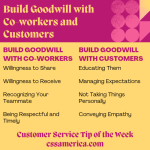
Build Goodwill with Co-workers and Customers - 11/10/26


All relationships are different.  We want to have good relationships with co-workers, after all – those are the people we spend the most time with each week.  We want to have good relationships with customers since they’re the ones that provide the revenue and inflows that allow us to Read more

How to Avoid “Groundhog Day” - 11/3/26


It’s Groundhog Day, where you’re living the same day over and over and over again. You have heard basically the same complaint from 4 different customers in the past week.  The bill is incorrect or confusing, and you’re having to spend a ton of time explaining things to the customer. You’ve Read more

Beware of Scary Telephone Customer Service - 10/27/26


As we near the Halloween holiday in the United States, it seems appropriate to discuss examples of scary customer service, particularly on the telephone.  Here are a few common issues that frustrate and annoy customers.  These are experiences to avoid delivering, and alternatives to adopt: The customer calls, describes their Read more

The Art of the Successful Script - 10/20/26


You’re the customer.  You go to the store, and they ask if you have a loyalty card.  You call the doctor’s office, and they ask for your birth date.   You walk up to the counter, and they ask if you found everything you were looking for. These are all valid Read more

The Key Building Block for Your Customer Relationship - 10/13/26


An automotive manufacturer gets supplies for their vehicles from all over the world.  They have arrangements, service level agreements, expectations for timing and quality of all the parts.  And when they gather all these supplies, they assemble the cars.  They test the cars.  Then they take pictures of those Read more

Be Flexible to Fill the Gaps - 10/6/26


The non-profit has the expected challenges.  There are only 3 people in the organization, yet, they have the same responsibilities of a larger company.  They have to do finance, sales, marketing; they deliver their services to the community, and they need to keep a pulse on what’s going on Read more

Is This Good Customer Service? - 9/29/26


A friend of mine reached out to me recently as she waited for the electrical technician to show up at her house to do some minor repairs.  She had never worked with this company before, but they sent a text about the tech who was soon to arrive. The message Read more

Ownership when Fixing Others’ Errors - 9/22/26


We were conducting training with a client recently, and one of the participants, Jackie, is in a role in his organization where he goes out to the customer site to investigate issues, address customer complaints, and fix problems.  While he’s at the site, he often gets an earful from Read more

Why “No” is So Important - 9/15/26


The employee told the caller: “I don’t think that is possible.” The customer eventually hung up, and redialed to ask a different employee the same question. The employee responded to the customer: “That’s probably not the best way to do it.”  Then, the customer kept asking question after question, arguing Read more

It’s Not “You,” It’s “I” - 9/8/26


During a business writing course that I took years ago, the instructor had us write an e-mail.  I can’t recall if it was written to a co-worker or customer, but after writing this e-mail, she had us count every “I” and “You.”  We talked about how we need to Read more

Change Your Style on the Fly – 5/22/18

Posted on in Customer Service Tip of the Week Please leave a comment


I was talking to a client recently, and we discussed the importance of relationship-building in their position. So I asked, “How do you develop a relationship?”

The client offered several points, one in particular piqued my interest – she said: “I have to understand how I communicate, and I have to be open to communicating differently.”

Essentially, she conveyed that she had to be self-aware, and she had to be willing and able to tweak her communication style to best work with the customer.

Being able to recognize what works with each client, knowing how to change, and being willing to change your style of communication based on the situation or the individual involved is a high-level customer service skill.

You have to know when to slow down your pace of talk based on how the other person prefers to communicate and how well they are understanding what you’re saying. You have to know when to sit or stand, lean-in or sit back based on what makes them more comfortable or builds their confidence.

You have to be willing to pick up a phone and call somebody even though you prefer e-mail, or be willing to meet with someone even though you prefer not to make the drive. Sometimes they want to text even though you have an aversion to doing that in business.

This is not to say we have to change who we are in any way. This is to say that if we want to deliver a great experience and build relationships, we have to understand each unique customer and what about their experience with us builds their comfort and confidence level. And since some of those experiential characteristics are communication-related on our part, we need to make the refinements necessary to build that client relationship.

Learn when and how to change your style on the fly.

Signup for FREE Tips!    Contact Us    More Resources for You    Visit Our Home Page


Choose Positivity – 1/2/18

Posted on in Customer Service Tip of the Week Please leave a comment


I had the opportunity to conduct employee focus groups and facilitate staff conversations for two different clients recently, and there was a common theme among all the groups. It’s intuitive, it’s understandable, but I was still surprised to hear the sentiment.

Employees consistently said they wanted to work in a more positive environment. Most of us would think that it’s intuitive that that’s what employees desire. Most would think it’s understandable that staff would share those perspectives. But I was somewhat surprised to hear it. Why?

Because, I sometimes have trouble understanding why people or organizations would consistently be negative, or why they would avoid sharing positives, or why their only form of motivation was criticism.

When people work 40 hours, 60+ hours a week, would they prefer to spend those 8/10/12 hours a day around others who are positive or negative? Would they prefer to be in an environment where they are appreciated? Would they prefer to have a reward for a great job or only punishment for a bad job?

I know that many are motivated to avoid the negative, or to avoid punishment, or not to get marked down or written up. But when you think of a healthy work environment, one where people’s values align to those of the organization, one where people WANT to go above and beyond – you are envisioning more positive organizations.

This is not a Tip just for managers; this is a Tip for you and me – everybody. People want positive reinforcement more than negative. They want optimism more than pessimism. They want “Let’s hope it works” rather than “I doubt it will.”

I’m not saying that we ignore the bad or should all be Pollyannas. What I am saying is that we have a choice in how we respond. We have a choice on what outlook we’ll take about a situation. We have a choice about how we engage others. We have a choice about whether we convey appreciation or just think it. And we have a choice about whether we look for ways to build up a co-worker or team, or we only look for ways to criticize.

When you make a choice, choose positivity.

Signup for FREE Tips!    Contact Us    More Resources for You    Visit Our Home Page


Are You a Debbie Downer or a Debbie Developer? – 11/14/17

Posted on in Customer Service Tip of the Week Please leave a comment


We’ve all heard of Debbie Downer (actually, if you haven’t, that’s probably a good thing). Debbie Downer was a character in “Saturday Night Live” – a person whose general attitude and actions brought down the environment, made everyone depressed – left others just sitting there…bummed.

However, I want to share something about a person of the same first name that I’ll refer to as “Debbie Developer.”

Debbie Developer is a client of mine (name’s been changed – I’m sure you’re shocked). She’s a training/development specialist, but much of her work over the past year has been with a new Service Excellence program. She’s well-respected by the CEO and has launched and successfully completed several large-scale initiatives over the past 2-3 years, in particular – initiatives that often go beyond the assumed responsibilities of someone in her role. And she does all this with a great customer service-oriented attitude.

Although her job is to develop skills in people, she also develops programs, she develops relationships, and she develops passion and energy around important projects. Here are three examples of how she develops with a customer service approach:

  • When she walks into a meeting, she’s curious, asks lots of questions, comes up with ideas. When someone comes up with a great idea, she literally says “That’s a great idea!” When someone asks an interesting question, she says “That’s an interesting question.” She engages, acknowledges, and reinforces others. She doesn’t just think positive thoughts – she conveys them to others.
  • When she’s given a task or project, she asks others how they would approach it, and she sends updates to keep them in the loop and let them know their input is requested and needed.
  • She’s quick to respond to e-mails and voice mails; in e-mails, she always starting with a greeting and ending with some positive statement or enthusiastic “Thanks!” She often calls instead of e-mails if there’s any need for dialogue or detail to best answer the co-worker’s e-mailed question.


This is simply a quick example of a person who exemplifies customer service excellence. She does it by doing the right things with the right attitude. She does it by treating others the right way.

Don’t be a Debbie Downer. Be a Debbie Developer.

Signup for FREE Tips!    Contact Us    More Resources for You    Visit Our Home Page