touch point | Customer Service Solutions, Inc. - Page 2

When to Avoid the Escalation - 6/16/26


The customer calls with a complaint, and the easy thing to do is to escalate it to your supervisor. That may also be the right thing to do, but how do you know when to avoid the escalation? Why You Would Escalate The first thing to consider is why you would Read more

Let’s be Clear on Clarity - 6/9/26


When trying to manage expectations, it’s vital to be clear with the customer.  But what specifically does it mean to be “clear?” Clarity is in the eyes and ears of the beholder, so what may be clear to one customer may be unclear to another.  However, there are some basic Read more

Allow Yourself to Solve a Couple Puzzles Every Day - 6/2/26


Frank had never been a dog owner before, and when he first got Bosco at the shelter, Frank didn't really know what he was doing.  He would try to be a good parent - feed the dog, play with it, take it on walks - but he was doing Read more

Improve with a Purpose - 5/26/26


If you’re reading these customer service tips, you likely want to get better.  You want an idea, a technique, a reinforcement, or a question that helps you improve. But why improve? At some point you may waver on the commitment to improve, because it can take effort, introspection, time, and change.  Read more

Reciprocate the Thanks - 5/19/26


Jasmine had a great experience with the company, and the company sent her a link to provide an online evaluation following the visit.  So, she clicked the link, gave a rating, and made a comment about her experience. The company monitored their online reviews, saw the positive response, and replied Read more

Don’t Skip the Recap - 5/12/26


The playoff hockey game goes on for almost 3 hours.  There’s non-stop action, with plenty of penalties and takeaways and hits against the boards…and a few goals, as well. You didn’t get to watch the whole game because you had other plans, but you wanted to know what happened.  So, Read more

Finalize the Solution with the 6 Step Checklist - 5/5/26


In last week’s Tip, we showed why and how to Use the 6 Step Checklist before Resolving the Issue.  We noted the importance of taking 15 seconds to mentally walk through the Who, What, When, Where, Why, and How to feel confident that you know what’s needed to fix Read more

Use the 6 Step Checklist before Resolving the Issue - 4/28/26


We talk about trying to resolve the issue right the first time, sharing the technique on how to manage the conversation to get clarity on the real issue, need, or goal, and confirming your understanding before moving forward. But what are you trying to clarify?  What are you trying to Read more

Use the Customer’s Words - 4/21/26


The customer is describing a problem on what they call their “computer.” They mentioned that the “screen” doesn’t “move from one page to the other.” They say that the “website’s name is typed at the top,” and it says sample.com with a “line, and then it says ‘home’ after Read more

Affirming the Customer with Empathy - 4/14/26


We’ve spoken and written about empathy for the 20+ years of these customer service tips, noting empathy as the most important quality any individual can have if they want to be great at customer service.  We’ve shared that - in order to serve our customers most effectively – it’s Read more

What to do DURING a Bad Experience – 5/15/18

Posted on in Customer Service Tip of the Week Please leave a comment


After providing the final research report to a client recently, even though the report provided tremendous detail and a 10-page Executive Summary, the client asked that I cull down the key takeaways to a few bullet points. As I glanced back through the report, there was one exceptionally interesting finding.

As background, this research was for an event that takes place annually. One of our approaches to analysis is to look at the characteristics of last year’s respondents and their individual responses to the survey, then identify which of those attributes strongly correlated to renewal and attendance at this year’s event.

One of the strongest factors impacting renewal to this year’s event was Event-related Communications. Last year’s event was negatively impacted by the weather, and it was interesting that many of the respondents felt better about the overall experience if they felt better about Event-related Communications, and they felt worse about the overall experience if they were not satisfied with the Event-related Communications.

Essentially, when an organization has challenges, a particular event as issues, a product or service has poor quality or lacks timeliness, the importance of effective communication ramps up dramatically.

When things are going bad, it’s better to overcommunicate than under communicate. It’s better to be more proactive and provide information above and beyond about what the issues are, what the resolutions may be, and what timeframes are expected.

It’s not just a good thing to keep customers in the loop, but when significant issues arise, those communications are often the difference between a renewal and a cancellation, the difference between keeping a customer and sending them to a competitor, the difference between a repurchase and lost business.

When you look at your ongoing customer Touch Point Strategies, make sure that there are specific strategies in place that enhance customer communications when the experience goes bad.

Know what to do during a bad experience.

Signup for FREE Tips!    Contact Us    More Resources for You    Visit Our Home Page


Why Your Customers Would Leave – 5/30/17

Posted on in Customer Service Tip of the Week Please leave a comment


We’ve written several TOWs over the years on Client Relationship Development, Touch Point Planning, and Retention & Growth strategies, and all – in some way, shape, or form – address Retention Drivers. We’ve offered many examples of Retention Drivers for particular industries like Sports, but let’s discuss how you determine the specific Retention Drivers for your business.

Why do customers stay with your company…and why would they leave?

Here are several questions to consider in order to uncover your customers’ unique retention drivers:

  • Why did they buy from your business in the first place, and is that part of the reason why they would buy again?
  • What aspects of their experience in working with your business have a significant impact on their decision to buy again?
  • What is it about the brand or reputation of your company that resonates most with them – and makes them want to be affiliated with you as a customer?
  • How much do they value having strong customer service and account relationships with your organization and your people?
  • How do they define “value,” and how important is value in their decision to return?
  • What is the most important factor in determining their willingness to return, and how do they perceive that your organization performs in that factor versus competitors?

Note that most of these questions focus on what’s MOST IMPORTANT to them and what actually drives decision-making. Keep in mind that many people will say that Price or Convenience or Customer Service or Speed of Delivery is important to them, but what actually causes them to choose Company A v. B?

Also note that these questions force us not to make assumptions. For example, don’t assume that the reason they bought first is why they continue to buy. Don’t assume that how you define your company’s competitive advantage matches how your customer perceives your business v. competitors.

Ask yourselves these questions (better yet, ask your customers), and learn their unique Retention Drivers.

Signup for FREE Tips!    Contact Us    More Resources for You    Visit Our Home Page


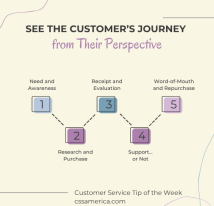
View Touch Points from the Customer’s Perspective – 5/28/13 TOW

Posted on in Customer Service Tip of the Week Please leave a comment

I received an email from my wireless telephone provider. They mentioned that I was now eligible for an upgraded phone at a discounted price (and if you’ve seen a 1990s flip phone, you’ll know why they want me to upgrade). Apparently the upgrade date had been reached, and I was eligible for the upgrade. One minute later, I received an email from the same provider telling me that it was an anniversary of sorts, and therefore I was eligible for an upgrade at a discounted price. About one minute later, I received a third email from the same wireless provider noting that I was now eligible for a discounted upgrade to my cell phone as a reward for my loyalty.

What the organization didn’t realize was that they were sending essentially the exact same e-mail at the exact same time with 3 different subject headings. The exact same upgraded cell phones were offered in each e-mail with those discounts available. So there may have been a Touch Point Plan that the provider had developed, but they were not looking at the plan from the customer’s perspective. Something that might have appeared very professional at first to the customer, turned out to be an aggravation after the third – essentially duplicate – e-mail arrived at my inbox.

If you work in a client relationship management role at your organization (for example, you’re a season ticket services representative for a sports team), this Tip of the Week is especially important for you. When you build your Touch Point Plans from the organization’s perspective, you determine when to send out information based on events or timeline triggers; make sure, however, that you’re not just looking at the plans from the organization’s perspective. Invert your Touch Point Plans to test them from the customer’s perspective to know what they’re going to receive and how they might perceive the information.

Develop Touch Point Plans from the customer’s perspective.