words

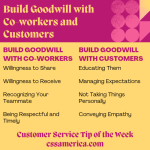
Build Goodwill with Co-workers and Customers - 11/10/26


All relationships are different.  We want to have good relationships with co-workers, after all – those are the people we spend the most time with each week.  We want to have good relationships with customers since they’re the ones that provide the revenue and inflows that allow us to Read more

How to Avoid “Groundhog Day” - 11/3/26


It’s Groundhog Day, where you’re living the same day over and over and over again. You have heard basically the same complaint from 4 different customers in the past week.  The bill is incorrect or confusing, and you’re having to spend a ton of time explaining things to the customer. You’ve Read more

Beware of Scary Telephone Customer Service - 10/27/26


As we near the Halloween holiday in the United States, it seems appropriate to discuss examples of scary customer service, particularly on the telephone.  Here are a few common issues that frustrate and annoy customers.  These are experiences to avoid delivering, and alternatives to adopt: The customer calls, describes their Read more

The Art of the Successful Script - 10/20/26


You’re the customer.  You go to the store, and they ask if you have a loyalty card.  You call the doctor’s office, and they ask for your birth date.   You walk up to the counter, and they ask if you found everything you were looking for. These are all valid Read more

The Key Building Block for Your Customer Relationship - 10/13/26


An automotive manufacturer gets supplies for their vehicles from all over the world.  They have arrangements, service level agreements, expectations for timing and quality of all the parts.  And when they gather all these supplies, they assemble the cars.  They test the cars.  Then they take pictures of those Read more

Be Flexible to Fill the Gaps - 10/6/26


The non-profit has the expected challenges.  There are only 3 people in the organization, yet, they have the same responsibilities of a larger company.  They have to do finance, sales, marketing; they deliver their services to the community, and they need to keep a pulse on what’s going on Read more

Is This Good Customer Service? - 9/29/26


A friend of mine reached out to me recently as she waited for the electrical technician to show up at her house to do some minor repairs.  She had never worked with this company before, but they sent a text about the tech who was soon to arrive. The message Read more

Ownership when Fixing Others’ Errors - 9/22/26


We were conducting training with a client recently, and one of the participants, Jackie, is in a role in his organization where he goes out to the customer site to investigate issues, address customer complaints, and fix problems.  While he’s at the site, he often gets an earful from Read more

Why “No” is So Important - 9/15/26


The employee told the caller: “I don’t think that is possible.” The customer eventually hung up, and redialed to ask a different employee the same question. The employee responded to the customer: “That’s probably not the best way to do it.”  Then, the customer kept asking question after question, arguing Read more

It’s Not “You,” It’s “I” - 9/8/26


During a business writing course that I took years ago, the instructor had us write an e-mail.  I can’t recall if it was written to a co-worker or customer, but after writing this e-mail, she had us count every “I” and “You.”  We talked about how we need to Read more

Simplify the Vocabulary – 9/9/14 TOW

Posted on in Customer Service Tip of the Week Please leave a comment


In our constant quest to find new ways to describe boring or irritating processes and services in a way that makes them sound exciting, we develop creative names: No Child Left Behind, Affordable Care Act, Permanent Seat Licenses, etc.

However, the problem is that our customers find out that this is typically not something to embrace, and the name becomes a joke or a punch line.

When we want to sound sophisticated, we use high-brow language: Six Sigma, OnBoarding, Rubric.

However, the problem is that our customers and employees have little-to-no idea what we’re discussing.

And sometimes, when we want to be specific, we risk using terms that mean different things based on the industry: Achievement, Bonding, Delegation, Enrollment, Gatekeeper, Grandfathered, Network, Rehab, Service Area, and Waiting Period.

Does Bonding relate to a mother and child, a company doing business in town, or teeth? Is a Delegation addressing something in healthcare or at the United Nations? Is the Gatekeeper a function in healthcare, a secretary who won’t let you see the boss, or – literally – a gate keeper?

When we use terms, we can’t assume that the customers know the terms. We can’t assume that if it’s used in our industry that the customer knows what “Enrollment” means in healthcare because their only exposure to “Enrollment” was at their child’s school.

The words matter, and we need to make sure the words are simple enough to be understood without requiring a detailed glossary to explain everything.

Go to your company’s website. Look at the patient or fan or employee or customer flyers and handbooks that you distribute. Give access to the website and these documents to people who know nothing about your business; ask them to read the information and interpret what it’s saying.

Make sure the words you use are clear enough to be understood. Simplify the Vocabulary.

Signup for FREE Tips!    Contact Us    More Resources for You    Visit Our Home Page


An Interesting Tip about Amazing Service – 5/13/14 TOW

Posted on in Customer Service Tip of the Week Please leave a comment


I listen to a sports talk show periodically, and the host has an interesting habit. He is always making statements such as “It’s really interesting that…” or “What’s amazing is that…” He will then follow-up that statement with an observation or conclusion that he wants you to find interesting, too – so you’ll keep listening.

Sometimes the conclusions aren’t the most interesting such as ‘What’s really amazing is that. . .when I watch the paint dry. . .it actually. . .dries!” Wow?

But there are three extremely useful tips that we can learn from this radio personality. First, the words you use matter – often tremendously. Our goal in customer service includes imparting a feeling to the customer or co-worker that we care for them, that they are valued, and that they are important. And our words impact their perception of whether we care.

Think about a situation where you’re a banker listening to a customer describe their need: “I am looking for a way to open my own jewelry making business using repurposed items like old necklaces, broken bracelets, etc. But I need some capital to acquire tools and develop a website.”

You could respond “We offer loans,” or you could respond “Wow! That’s a really interesting concept; what a great idea to use old jewelry to make attractive, new items to sell! And we definitely have funded many creative companies like yours.”

In both cases you might provide the loan, but which response will more quickly establish a rapport and increase the likelihood of the customer wanting to go with your bank?

What about the patient in the physician’s practice that notices a spill that nobody cleaned up? You could respond “We’ll take care of that,” or you could respond “Thanks so much for bringing that to my attention. That helps a lot – we don’t want anyone stepping in it or slipping. I REALLY appreciate it.”

Which response better conveys how much you value them and what they’ve done?

Second, avoid a tone that wreaks of sarcasm or indifference – offer a sense of sincerity with your tone. And third, avoid the hyperbolic statement such as: “Thank goodness you told me about the spill! Someone could have died! You just saved a life!”

Remember that the sincere interjection of some key words (interesting, amazing, appreciate, thank, sharing, etc.) helps the other person to feel valued, important, and appreciated.

Convey interest with a few amazing words.


« Previous   1 2 3 4 5 6 7 8 9 10 11 12 13 14