
Customer Service Tip of the Week

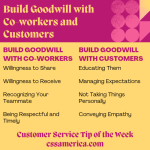
Build Goodwill with Co-workers and Customers - 11/10/26


All relationships are different.  We want to have good relationships with co-workers, after all – those are the people we spend the most time with each week.  We want to have good relationships with customers since they’re the ones that provide the revenue and inflows that allow us to Read more

How to Avoid “Groundhog Day” - 11/3/26


It’s Groundhog Day, where you’re living the same day over and over and over again. You have heard basically the same complaint from 4 different customers in the past week.  The bill is incorrect or confusing, and you’re having to spend a ton of time explaining things to the customer. You’ve Read more

Beware of Scary Telephone Customer Service - 10/27/26


As we near the Halloween holiday in the United States, it seems appropriate to discuss examples of scary customer service, particularly on the telephone.  Here are a few common issues that frustrate and annoy customers.  These are experiences to avoid delivering, and alternatives to adopt: The customer calls, describes their Read more

The Art of the Successful Script - 10/20/26


You’re the customer.  You go to the store, and they ask if you have a loyalty card.  You call the doctor’s office, and they ask for your birth date.   You walk up to the counter, and they ask if you found everything you were looking for. These are all valid Read more

The Key Building Block for Your Customer Relationship - 10/13/26


An automotive manufacturer gets supplies for their vehicles from all over the world.  They have arrangements, service level agreements, expectations for timing and quality of all the parts.  And when they gather all these supplies, they assemble the cars.  They test the cars.  Then they take pictures of those Read more

Be Flexible to Fill the Gaps - 10/6/26


The non-profit has the expected challenges.  There are only 3 people in the organization, yet, they have the same responsibilities of a larger company.  They have to do finance, sales, marketing; they deliver their services to the community, and they need to keep a pulse on what’s going on Read more

Is This Good Customer Service? - 9/29/26


A friend of mine reached out to me recently as she waited for the electrical technician to show up at her house to do some minor repairs.  She had never worked with this company before, but they sent a text about the tech who was soon to arrive. The message Read more

Ownership when Fixing Others’ Errors - 9/22/26


We were conducting training with a client recently, and one of the participants, Jackie, is in a role in his organization where he goes out to the customer site to investigate issues, address customer complaints, and fix problems.  While he’s at the site, he often gets an earful from Read more

Why “No” is So Important - 9/15/26


The employee told the caller: “I don’t think that is possible.” The customer eventually hung up, and redialed to ask a different employee the same question. The employee responded to the customer: “That’s probably not the best way to do it.”  Then, the customer kept asking question after question, arguing Read more

It’s Not “You,” It’s “I” - 9/8/26


During a business writing course that I took years ago, the instructor had us write an e-mail.  I can’t recall if it was written to a co-worker or customer, but after writing this e-mail, she had us count every “I” and “You.”  We talked about how we need to Read more

Critique Yourself before Others Do – 10/11/22

Posted on in Customer Service Tip of the Week Please leave a comment

When we’re criticized, we can get defensive, push back, deflect blame to others, and focus more on defending ourselves than really listening to what the other person is saying.  And some of us who get defensive, once we allow our emotions to settle, take time to reflect on what the other person said.  We sometimes are willing to see those kernels of truth.  We are willing to learn from them and possibly make a change moving forward.

While it’s not great to be defensive, it’s often a natural reaction.  It’s also a sign of maturity and wisdom to be able to overcome that initial defensiveness and try to get some lessons learned from what the other person said.

But what if we critiqued our own mistakes before the customer or co-worker complained?  Not everything we do imperfectly or incorrectly or not on a timely basis or not in the best way possible is something that’s going to draw a complaint.

If you’re like me, you probably make little mistakes every single day.

We make many decisions every day, so it’s natural that some of those decisions are going to be wrong.  The resulting action or inaction could be wrong.

Self-critiques that can lead to Self-improvement

But when we know in our gut or it’s clear based on some reaction/data/feedback that we didn’t do our best, we have to learn from our own mistakes:

  • I really should have called that person back when I first thought about it.
  • I knew I should have had somebody check my work before I moved it to the next step.
  • I should have paused and thought through what might happen on that call before I responded to the customer.
  • I really should have listened one more minute or asked one more question before sharing my thoughts.
  • That meeting took a lot longer than it could have, and if I had just gone in a little bit more prepared, we probably would have ended on time.
  • That would have gone much better if I stopped sending e-mails and just picked up the phone and called the person.
  • That call would have been a lot cleaner if I would have looked away from the computer screen and focused totally on the caller.

If we make these comments to ourselves and put lessons learned into place, then maybe we would have fewer reasons for the co-worker or the customer to critique us.  And if they did critique us, we probably would have already had that conversation with ourselves about a very similar issue, and we might understand their critique more because we heard it from ourselves first.

Therefore, we might not respond so defensively, we might not get so emotional, and we might actually understand where they’re coming from a lot sooner.

If you critique yourself before others do, the critiques of others won’t affect you as much.

Signup for FREE Tips!    Contact Us    More Resources for You    Visit Our Home Page


Find a Connection Point – Part 2: Situational Connection – 10/4/22

Posted on in Customer Service Tip of the Week Please leave a comment

Last week we highlighted key topics to consider when you want to find Personal Connection Points with the customer.  Today, we’ll cover some key questions to ask to uncover information about today’s situation that you can use to establish a rapport with the customer.  This is Part 2 – Topics that create these connections About The Now:

About The Now

Whether you’re dealing with a new customer or an existing customer coming in upset, you can connect with the customer about what is going on today, right now.  Noted below are 3 categories of connection points that are more about today’s situation.

Environment – What’s the weather like outside?  Is the building pretty, clean, bright, or easy to navigate?  Are they using a mobile device or tablet or computer, and is that what you are using or could be using, as well?

Situation – Have you had other customers who’ve dealt with the situation they’re describing?  Have you personally dealt with a similar situation?  Are there lessons learned in those situations that you can share with them to paint a picture of next steps or final resolutions?

Goals – If you understand their goals, is there some way you can relate to their goals?  Do you understand why they want what they want?  I’m not asking do you agree with their goals; I’m just asking if you can understand and appreciate why they are seeking a particular solution?

Just like we noted in the Part 1 Tip last week, you could ask some of these questions, but it’s just as important to listen closely to what they convey, learning the specifics of what they share, so you can use that information to connect with them, to build rapport.

Find some Situational Connection Points.

Signup for FREE Tips!    Contact Us    More Resources for You    Visit Our Home Page


Find a Connection Point – Part 1: Personal Connection – 9/27/22

Posted on in Customer Service Tip of the Week Please leave a comment

Some people are born almost like a master at communication.  They know how to establish rapport with just about anybody, and they do so in a way that seems so natural and so real.  They can form relationships and be laughing with somebody they met two minutes ago like it’s someone they’ve known for years.

But for most of us, it’s not a talent or quality we were born with; it’s something that we need to work on, and in customer service there’s a lot of benefits to being able to establish rapport and begin to develop a relationship.

It could be a new customer that you’re wanting to provide a great experience to and lay the groundwork for a long-term relationship.  Maybe it’s an existing customer that’s coming in a little irate, griping a little bit, who’s a little bit upset. One way to take away some of the emotion and disarm them is to find some common ground so it doesn’t seem so adversarial.

There are ways to communicate that foster these connections, and we’re going to address some topics you can discuss in a 2-Part series.  For this week, Part 1 of our focus on the topics that create these connections is About Them and You:

About Them and You

Noted below are 3 categories of connection points that are more about the people involved – you and the customer.

Background – Where were they born or grew up?  Where have they lived in the past or currently reside?  What type of work have they done or do they do today, and in what industries?  What types of organizations or initiatives have they been a part of over the years?

Experiences – What are their hobbies?  What do they like to do to relax or stay active?  Where have they vacationed, what are their interests, and what are their leisure activities?

Friends/Relatives – Are they a parent?  Do they have siblings or friends with whom they do things?  Do they live near family, or are they traveling to visit?  Are they a pet lover?

If you uncover some of these points, you may find some things that you can relate to about the other person, and they can relate to you a little bit better, as well.  By either asking the questions directly when appropriate or just doing an exceptionally good job at listening to the details of what they share, you can establish that rapport.

Find some Personal Connection Points.

Signup for FREE Tips!    Contact Us    More Resources for You    Visit Our Home Page