alternative solution

Use What the Customer Gives You - 8/25/26


Scenario #1: The customer sent an e-mail to the general inbox at the company.  The message noted that the customer needed to get a family member added to their account, but they couldn’t tell from the website how to do so. The next morning an employee opened up the e-mail, Read more

How Better Customer Service is Better for You - 8/18/26


Oftentimes, we have employees in training or workshops who really want to understand what’s in it for them to deliver better customer service.  How does the employee benefit from a better customer experience? Noted below are 5 different aspects of a great experience desired by the customer.  What if... The customer Read more

Manage New Customer Expectations - 8/11/26


The fan had never been to a motorsports event before, but they had been to concerts.  They had been to big conferences.  At those other events, they could park right next to the venue, many of the activities were indoors, and weather was a non-issue.  So, they were not Read more

Complement Empathy with Action - 8/4/26


A man falls into a hole, and he can’t get out.  He starts yelling for help, and a doctor walks by and looks down the hole.  The man in the hole yells to the doctor “Please help me.  I’ve fallen into this hole!”  And the doctor takes out a Read more

My 8-Minute Visit at the DMV- 7/28/26


I needed to get a Real ID, which in North Carolina facilitates airline travel and other identity verifications.  My wife suggested I go to one particular DMV that was a LONG way away from home, but where she had experienced great customer service.  I was lucky to find an Read more

When They Might Walk Out the Door…Permanently- 7/21/26


Have you ever had one of those conversations with the customer where they literally tell you they’re about to stop doing business with your company?  This is it.  They may bring up a competitor or found another way to get their need met, or they are just leaving. When we Read more

Transparency in Customer Service- 7/14/26


We’ve worked with a lot of clients in the local government sector, and many of these clients have Customer Service Standards and/or corporate values that include Transparency. Think about an old-fashioned transparency sheet, that malleable see-through page you put on an overhead projector.  You can see everything on one side Read more

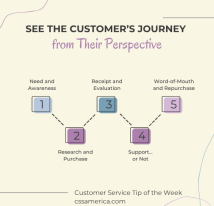
See the Customer’s Journey from Their Perspective- 7/7/26


That customer is face-to-face with you right now, and you are fielding their questions or delivering your service to them.  And oftentimes and understandably, we are so immersed in the moment that we don’t think about what came before or think enough about what comes next. But in the life Read more

Gaining the Benefits of the Greeter- 6/30/26


Most likely, we’ve all entered some establishment – a retail store, restaurant, or service center - when there is a greeter at the door.  The most famous greeter position is probably the Walmart greeter.  I often thought that my father-in-law would have been a fantastic Walmart greeter, because he Read more

Seamlessness - Why the Customer Thanked You - 6/23/26


This doesn’t happen enough nowadays, but the employee received a long thank you e-mail from the customer.  A financial services account manager had taken care of the client during a period of time that was stressful for the customer. Life was unexpectedly changing quickly, and personal emotions, additional financial responsibilities, Read more

Plant the Seed of Customer Service Success – 6/7/16 TOW

Posted on in Customer Service Tip of the Week Please leave a comment


After many stories over the years of poor customer service in a big box home improvement store, here’s a positive story – it’s a story about how ideas sometimes are better than answers.

If you’ve ever been a novice gardener (which I am) somehow heading up a community garden (which I am) and seeing plants having their tops eaten off about 3 feet above ground (which is happening), you know the pain I’m feeling. The entire community garden is fenced in, so there’s only one way in – OVER the fence.

Yes, deer are jumping over our 7-foot fence like it was a 6” curb, and they’re having some glorious meals! Since I’m not any kind of expert gardener nor an expert in all things deer, I Googled my heart out only to find some less-than-appealing solutions often having to do with other animals or Irish Spring soap.

The most logical suggestion is to raise the fence.

So I went to a local big box home improvement store and wandered around somewhat aimlessly when – shock of shocks – an employee walked up to me and asked if he could help.

“I’m not even sure what I’m looking for,” I replied, “but here’s my issue.” I explained the issue and told him about my thought of how to raise the 22 posts around the garden by 3 feet using a particular type of tapered metal spike.

If he were to answer my question about whether they had such a spike, the answer would have been “No.”

Instead, he offered multiple ideas, multiple options – all were ways to raise the height with different types of materials, different ways to secure this additional 3-feet of fence to the posts. He didn’t answer a question about the spike – he offered a multitude of sound ideas to address the problem.

This is the 20th century, and many people can get an answer from the internet, so when they go to you for service – to help with a need or issue – they often need something more than an answer. They want creative ideas that lead to options and ultimately – a cost-effective quality solution.

When faced with a customer’s question, assess the question to understand the “why” of it. What they may really be seeking is your idea, your creativity, your solution. These are the times when your “No” won’t help them, but your consultative support will.

Know when a customer wants an idea, not just an answer.

Signup for FREE Tips!    Contact Us    More Resources for You    Visit Our Home Page


Go for the Hard Yes Over the Easy No – 4/12/16 TOW

Posted on in Customer Service Tip of the Week Please leave a comment


The customer was telling his business partners about what a great job the lender did for him. Before that, the customer was happy and joking with his account representative, Jay. Before that, Jay was getting him the paperwork that provided the funding the customer needed.

Prior to that, Jay offered the customer a couple options for funding his equipment purchases. Prior to that, in a response to a question from the account representative, the customer told Jay his business goal. Prior to that, Jay said No.

Jay said No because the customer had asked for a specific type of loan for which he wasn’t qualified.

We’re tracking here – we’re tracking back from the positive Word-of-Mouth that Jay was receiving to the inception of the conversation – when the customer asked for something that could not be done.

Jay opted for the “Hard Yes” over the “Easy No.” He said No initially because policy warranted the response, but he moved deeper into the conversation. He probed for the core need. He cared enough to ask the questions that led him to an answer.

Follow Jay’s lead. Go for the Hard Yes over the Easy No.

Signup for FREE Tips!    Contact Us    More Resources for You    Visit Our Home Page


Have a HOFAS Talk – 11/10/15 TOW

Posted on in Customer Service Tip of the Week Please leave a comment


I was dealing with an issue at a non-profit organization where I volunteer, and the employees were in a disagreement about how to handle a situation. There was no shortage of opinions, and the rumor mill was rampant. Much of what was said behind the proverbial closed door was negative about “them,” whoever “them” was to the one speaking.

To begin to deal with the issue, we began to facilitate small group conversations. The goal was for people with differing opinions to talk out in the open with each other so – eventually – everyone would have a fuller understanding and some empathy for others. This would create the platform from which progress and decisions could be made.

I bring this up because the 5 core principles we used in the conversations could be applied to most significant issues you might have with an irate customer or co-worker. The acronym to remember is HOFAS:

  • History – Get the facts of the situation, the background clear. Ensure that you’re starting the conversation with the same understanding.
  • Opinions – Encourage people to offer their perspective. Try to avoid arguing with their opinions; remember that those are just opinions, not facts, and people are generally entitled to opinions.
  • Feelings – Let them get the emotions out. If people can vent, they can usually blow off steam and begin to calm down.
  • Alternatives – Identify potential next steps, sometimes soliciting their ideas for resolutions, and often trying to identify more than one solution in order to offer everyone choices and flexibility.
  • Solutions – Determine which action to take, and which solution to pursue. Confirm what you all decided would be the next steps and timeframes.

 
You want to start these conversations by noting the 5 core principles and sharing that all comments should be provided in a manner that’s helpful and respectful. This reinforces the desired tone of the conversation and suggests that the discussion be about the issue, not the individual.

When dealing with the irate customer or co-worker, ensure the other person gets to talk. People want to be heard and to feel that they matter.

Have a HOFAS talk.

Signup for FREE Tips!    Contact Us    More Resources for You    Visit Our Home Page