issue resolution

It Shouldn’t Make a Difference, But… - 9/1/26


We have this conversation with lots of our sports clients, but the principles apply across all different industries.  Too many service representatives view a conversation with a customer as a transaction.  Just get him off the phone as quickly as possible.  The customer is Joe Public, not Joseph Pendergrass.  Read more

Use What the Customer Gives You - 8/25/26


Scenario #1: The customer sent an e-mail to the general inbox at the company.  The message noted that the customer needed to get a family member added to their account, but they couldn’t tell from the website how to do so. The next morning an employee opened up the e-mail, Read more

How Better Customer Service is Better for You - 8/18/26


Oftentimes, we have employees in training or workshops who really want to understand what’s in it for them to deliver better customer service.  How does the employee benefit from a better customer experience? Noted below are 5 different aspects of a great experience desired by the customer.  What if... The customer Read more

Manage New Customer Expectations - 8/11/26


The fan had never been to a motorsports event before, but they had been to concerts.  They had been to big conferences.  At those other events, they could park right next to the venue, many of the activities were indoors, and weather was a non-issue.  So, they were not Read more

Complement Empathy with Action - 8/4/26


A man falls into a hole, and he can’t get out.  He starts yelling for help, and a doctor walks by and looks down the hole.  The man in the hole yells to the doctor “Please help me.  I’ve fallen into this hole!”  And the doctor takes out a Read more

My 8-Minute Visit at the DMV- 7/28/26


I needed to get a Real ID, which in North Carolina facilitates airline travel and other identity verifications.  My wife suggested I go to one particular DMV that was a LONG way away from home, but where she had experienced great customer service.  I was lucky to find an Read more

When They Might Walk Out the Door…Permanently- 7/21/26


Have you ever had one of those conversations with the customer where they literally tell you they’re about to stop doing business with your company?  This is it.  They may bring up a competitor or found another way to get their need met, or they are just leaving. When we Read more

Transparency in Customer Service- 7/14/26


We’ve worked with a lot of clients in the local government sector, and many of these clients have Customer Service Standards and/or corporate values that include Transparency. Think about an old-fashioned transparency sheet, that malleable see-through page you put on an overhead projector.  You can see everything on one side Read more

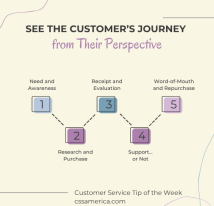
See the Customer’s Journey from Their Perspective- 7/7/26


That customer is face-to-face with you right now, and you are fielding their questions or delivering your service to them.  And oftentimes and understandably, we are so immersed in the moment that we don’t think about what came before or think enough about what comes next. But in the life Read more

Gaining the Benefits of the Greeter- 6/30/26


Most likely, we’ve all entered some establishment – a retail store, restaurant, or service center - when there is a greeter at the door.  The most famous greeter position is probably the Walmart greeter.  I often thought that my father-in-law would have been a fantastic Walmart greeter, because he Read more

Dealing with the Issue of Blaming – 9/11/18

Posted on in Customer Service Tip of the Week Please leave a comment


He who cannot dance claims the floor is uneven.

A bad workman blames his tools.

Blame is like the lightning; it hits the highest.

Let’s talk about blame. Often in the world of customer service, we are responding to an issue or a complaint, and usually there is a cause for that complaint. Highlighting the cause, if done incorrectly, often includes blame. But we need to understand what blame does and does not do.

Blame does not move someone closer to a resolution. Blame does not build rapport and relationships. Blame does not keep the issue from arising again. Blame does not keep the conversation in an even and professional tone. Blame does not allow for acceptance of personal responsibility by the “blamer.”

Instead, blame can be like the lightning. It can cause the damage. It can make a loud noise. It can create an adversarial situation or adversaries. It can cause us to look at others or at other things to identify what they did wrong instead of looking at ourselves for what we could do differently next time.

In other words, blame doesn’t really get us anywhere. And when you are in a difficult situation with a customer or a coworker, you need to get SOMEWHERE. You need to find some common ground. You need to figure out how to move forward. You need to find some kind of a solution or some kind of a way to a next step. You need to figure out how to maintain or build a relationship.

When dealing with difficulties with others, avoid blame. Don’t blame the tools or the dance floor.

Look for positive and productive ways to move forward.

Signup for FREE Tips!    Contact Us    More Resources for You    Visit Our Home Page


Of Ross, Unagi, and the Attacking Customer – 6/19/18

Posted on in Customer Service Tip of the Week Please leave a comment


If you’ve ever watched the TV sitcom called Friends, you may remember that one of the characters was named Ross. In one episode, he is trying to educate some of his female friends (who just took a self-defense course) on a concept he calls Unagi. Basically, to Ross, this is a concept that would help him anticipate when he was about to be attacked. Once attacked, then he could use his karate. Of course, Ross got his terms confused; he should have said Zanshin; instead he used Unagi – a Japanese word for freshwater eel.

Ross also wasn’t particularly good at Unagi or karate, as later in the episode his Friends “attacked” him when his Unagi failed, and they got him in a submission hold.

In the world of customer service, it would be great if we had Unagi. It would be great if we had some kind of a radar that could anticipate that customer who is going to attack us or bully us into getting what they want.

Unfortunately, for the most part, Unagi does not exist. However, these are 3 different tactics to consider when you’re faced with a customer potentially trying to bully his way to a particular outcome:

Restrain – Hold back on the urge to verbally fight back with personal attacks against the customer, blaming them for things that have happened in the situation. Once we heighten our emotional level and try to match theirs, usually we’re going to end up having a situation get even worse. Restrain a little bit instead of reacting with defensiveness and our own personal feelings.

Redirect – Consider ways to get the conversation away from the personal attack and away from their solutions to focus more on a scenario where you are redirecting the conversation by asking questions. You’re trying to learn details. You’re trying to understand specifics, and all the while by asking your questions you’re not only getting the conversation to focus on what you want to focus on, but you’re also taking control of the conversation.

Recuse – At some point, the conversation gets too heated; it’s too personal; you may need to recuse yourself from the conversation. This does not mean to ignore the customer and the issue. What it does mean is that sometimes it’s best to bring in a co-worker, bring in a supervisor, bring in somebody else and recuse yourself from the situation. Oftentimes that mere pause for the handoff can deescalate the emotions. By bringing in someone else, it gets the focus off of you and the dynamics with you and the customer. Sometimes the customer feels they’re making progress through a resolution process by viewing the next person (especially if you position the handoff this way) as a key next step in the process.

Why you might not have Unagi, find ways to restrain, redirect, and – if necessary – recuse yourself when you’re dealing with the attacking customer.

Signup for FREE Tips!    Contact Us    More Resources for You    Visit Our Home Page


When it’s – Truly – Not Your Fault – 6/12/18

Posted on in Customer Service Tip of the Week Please leave a comment


Jennie was under fire. She was the first line of defense – the front-line worker in the software firm. She didn’t make the software. She didn’t cause it to have errors. She wasn’t the one apparently avoiding the biggest customer’s calls.

Yet, here she was – dealing with the issue, the anger, the emotion of the customer, and it was truly NOT her fault.

This is when you could have one of a number of urges – you can argue, you can ameliorate (an underrated word!), you can obfuscate (nice SAT word!), you can empathize, or you can throw your co-worker or company “under the bus.”

This is the time to hold back on that last urge – don’t take down a co-worker to take down the customer’s emotion. This is when that phrase “you have to be the bigger person” comes into play. The best response to a customer situation is not always what we’d prefer to do. The best response is often not the easiest. The best response isn’t always painless in the short-term.

The best response – when it’s truly not your fault – starts before you get into the technique, the wording, the engagement with the customer. The best response starts before you respond to them – it starts with how you decide to handle yourself.

It’s a matter of having the conscious thought that “It’s not about me. Let me do what’s best for the customer and the company. Let me focus on others – not focusing on who’s to blame (or not to blame, in this case).”

It’s a mindset and a realization that – yes – you have to be the bigger person.

Thanks for what you do as a customer service representative of your organization.

And thanks for what you don’t do – namely throwing your co-worker “under the bus.”

Signup for FREE Tips!    Contact Us    More Resources for You    Visit Our Home Page


« Previous   1 2 ... 7 8 9 10 11 12 13 14 15 16 ... 22 23   Next »